By Cindi John
BBC News community affairs reporter |

 Everyone stopped is entitled to a copy of the report of the incident |
From Wednesday anyone stopped - not just those later searched - by police in London must be given a written record of the incident. The scheme has been piloted by officers on the beat in east London for more than a year. With obviously practised ease Pc Michael Cassidy fires off questions and writes the responses rapidly on the form he's holding.
He's conducting a 'stop' under the Metropolitan Police's new 'stop and account' procedure.
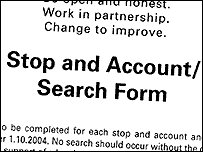
Under the new measures, everybody stopped - not just those subsequently searched - are entitled to a written record of the incident.
It was one of the recommendations of the Macpherson report which followed an inquiry into the Met's investigation of the death of black teenager Stephen Lawrence.
 |  They still just stop people when they feel like it They still just stop people when they feel like it |
John O'Dale, who's been stopped by Pc Cassidy on the outskirts of the Woodberry Down estate in Hackney, takes the delay with good grace. He says he's been stopped a couple of times recently.
"I don't mind, it's no big deal. If they get guns and whatever off the streets by stopping people, good luck to them, let them do it," he says.
'Transparent'
But not everybody PC Cassidy and his partner on the beat, Pc James Minney, encounter are as relaxed as John O'Dale about being questioned.
 PCs Michael Cassidy and James Minney have helped pilot the scheme in Hackney |
Emmanuel Adjei, 24, who was also questioned about his presence near Woodberry Down estate, says many stops are unjustified. "At the end of the day they still just stop people when they feel like it.
"We're not doing anything, they're not arresting anybody, so they've stopped us for no reason," he says.
The police's use of stop and search has long been controversial with concern about disproportionate numbers of ethnic minorities in the annual figures.
A report by the Metropolitan Police Authority (MPA) published in May claimed the practice was "influenced by racial bias" and that black people were four times more likely to be stopped than white people.
However, Hackney borough's head of operational support, Chief Inspector Don Smith, believes the new procedure makes the force more accountable.
That's because for the first time the total number of people stopped will be on record - not just those who are ultimately searched, he says.
"Clearly the officers will be making a record of all the people they stop and that can only be seen as a good thing because it makes the officers accountable and makes the organisation transparent," he says.
Paperwork
Police in Hackney started piloting the scheme along with officers in Tower Hamlets in April 2003.
See the front page of the form 
|
Currently officers in Hackney are carrying out around 800 'stop and accounts' per month, up from around 500 when the pilot began. Concern has been raised by the Metropolitan Police Federation about the increase in paperwork for officers.
It says the procedure "uses up valuable officer time" and it is calling for the procedure to be "streamlined".
After 18 months piloting the new scheme Pc Michael Cassidy says there's no doubt it does increase paperwork.
"Recently there has been a new form which is better. A stop can take up to half an hour and the whole time you're writing things down," he said.
But overall the targeted use of 'stop and account' had led to a drop in crime - particularly street robberies - in the area, he added.
"It's one of our main tactics against street crime and we've managed to get the figures down considerably. It was completely out of control before and we've managed to get back on top of it now," Pc Cassidy said.


 One-Minute World News
  News services

 E-mail this to a friend
  Printable version
 Enlarge Image