|
 |
 | | | | | | |||||||||||||||||||||||||||||||||||||||||||||||||||||||||||||||||||||||||||||||||||||
| | | You are in: UK | |||||||||||||||||||||||||||||||||||||||||||||||||||||||||||||||||||||||||||||||||||||||
|
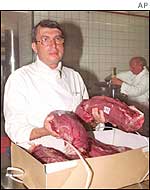
| | Wednesday, 25 September, 2002, 02:12 GMT 03:12 UK British beef's tough time 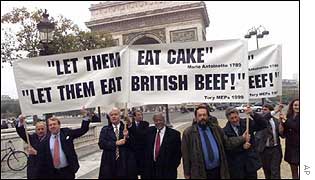 The French ban angered farmers and politicians With the news that the first exports of British beef since the foot-and-mouth crisis are to leave for the continent, are things about to turn around for the beleaguered industry? BBC News Online takes a look back on two decades of disaster for Britain's cattle farmers. It's been a tough time for British beef. For more than six years, beef farmers have had to contend with export bans borne out of the BSE and then foot-and-mouth crises that have decimated their industry. But as far back as the 1980s and 1990s CJD - or mad cow disease - blighted business. British beef was once the favourite of top chefs, typified by the presence on discerning dinner tables across the world of prime Scottish rump steak. But growing awareness of the link between BSE in cattle and CJD in humans saw it become the butt of jokes and its reputation plummet.
Most damaging of all, it came to be almost universally regarded as unsafe. Contaminated beef in the 1980s was almost certainly the root cause of CJD in humans that emerged a decade later and the eventual spread of which is still unknown. Although there are now believed to be fewer people than once feared incubating the disease in Britain, the toll could still run into several thousands. Scenes of once-healthy teenagers and elderly victims falling prey to the slow, degenerative brain disease were shown around the world alongside pictures of cows happily grazing in the UK countryside. The seeds of the stigma were sown. CJD, or Creutzfeldt-Jacob disease (and later variant or vCJD and new variant or nvCJD) is an untreatable and invariably fatal disease in humans which is similar to BSE in cattle and scrapie in sheep. Export market In 1996, because of the prevalence of BSE in British cattle, the French Food Safety Agency slapped a ban on all British beef. Before then, France had taken more than 100,000 tonnes of beef from the UK annually. BSE destroyed the market for British beef both in France and everywhere else, leaving exports running at barely 500 tonnes a year. During 1995, the last full year of beef exports before the BSE outbreak, 274,000 tonnes of the meat, worth �520m, were sold worldwide. Things were not helped when France ignored a European Commission ruling in 1999 which declared British beef safe again - despite threats of �100,000 daily fines until the ban was dropped. It was another three years before they relented. But during that time the foot-and-mouth outbreak heaped further misery on Britain's farmers. Epidemic With the BSE disaster still fresh in the minds of certainly the French, and to a lesser degree, the rest of the meat-eating world, the new crisis could hardly have come at a worse time. At its height more than 2,000 cases were confirmed. The government resorted to mass slaughter to control the infection and images of huge burning pyres were seen around the world. And so to another British beef ban. On 21 February last year the EU ordered a halt in all exports which was not lifted again until January this year, following the granting of "disease-free status" to the UK. That ban may not have stretched to six years, but it nevertheless had a devastating effect on both profits and reputation, already severely dented by BSE gone before it. Wednesday's exports from Wales are certainly a welcome step on the road towards recovery for the industry which has lost billions. But how long it will take before British beef is accepted back on the world's dinner tables remains to be seen. | | See also:  25 Sep 02 | UK 20 Sep 02 | World at One 20 Sep 02 | Europe 16 Jul 02 | Science/Nature 09 Aug 01 | UK Internet links: The BBC is not responsible for the content of external internet sites Top UK stories now: Links to more UK stories are at the foot of the page. | |||||||||||||||||||||||||||||||||||||||||||||||||||||||||||||||||||||||||||||||||||||
| |
|  E-mail this story to a friend E-mail this story to a friend |
| |
| Links to more UK stories |
| | | ||
 | ||||
 | | Back to top
| ||
| ---------------------------------------------------------------------------------- To BBC Sport>> | To BBC Weather>> | To BBC World Service>> ---------------------------------------------------------------------------------- © MMIII | News Sources | Privacy |