|
 |
 | | | | | | |||||||||||||||||||||||||||||||||||||||||||||||||||||||||||||||||||||||||||||||||||||||||||||||||
| | | You are in: UK | |||||||||||||||||||||||||||||||||||||||||||||||||||||||||||||||||||||||||||||||||||||||||||||||||||
|
| | Thursday, 15 August, 2002, 17:06 GMT 18:06 UK Waiting for the fatwa 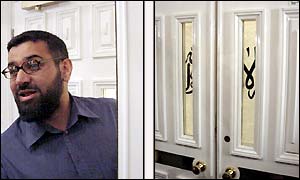 You're not coming in: Anjem Choudary closes the doors
 Many years later a very different group, viewed by government with similar disdain, managed to suffocate itself without any help at all - despite journalists being ready and willing to hear what they had to say. Al Muhajiroun, a small, radical Islamist outfit, called us to a delightful central London hotel to tell us all about its fatwa, a religious edict, on what it believed Muslims should do in the even of an attack on Iraq.
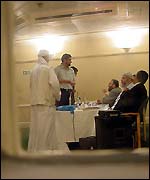
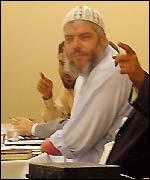
It has called for a British Islamic state and attacked the West over the war in Afghanistan. The invitation to this event described the US's campaign as a "crusade against Muslims". What made this meeting important was, in al Muhajiroun's words, "the most radical" speakers of the hardline fringe would be speaking together - a rare opportunity indeed. Inside the room were Abu Hamza al-Masri, the one-eyed, one-armed north London cleric who is said to have received his injuries fighting the Soviets in Afghanistan; Sheikh Omar Bakri Mohammad, the self-styled head of the UK Sharia Court; Saudi dissident Dr Muhammad al-Massari and Yasser al-Siri, a London bookseller who recently beat off a US attempt to have him extradited over alleged links to al-Qaeda. Entrance fee Then, as journalists approached the door to the hotel's Stockholm Suite, the group's leader Anjem Choudary demanded �30 per head to hear the hardliners speak.
"We have got Muslim leaders from all over the country together for you," he said. "We think it's reasonable to ask you to pay for the privilege of hearing them speak." "Well, we'll just have to boycott your press conference then," said one reporter. "You are most welcome," said Mr Choudary. "It is a nice day outside." With camera lens pointing through the gaps in the doors, Mr Choudary re-emerged. "How exactly do you expect us to report this if you are not going to let us in the room?" came the question. "Sheikh Omar said that if any of you declare the Shahada [profession of Muslim faith] you are welcome to come in." So with a sizeable detachment of the British and foreign media camped outside, Sheikh Omar Bakri and co began preaching to the converted in the shape of supporters already on the inside. If al Muhajiroun was going to convince the British public that it was at the vanguard of a revolution, it was going to have a hard job doing it without telling the media. Books for sale After a few minutes, an earnest-looking young man wheeled out a trolley of books in the vain hope that reporters would part with cash by other means. "What are they are about?" we asked. The earnest-looking young man wheeled the books back inside. Departures and chaos At midday, Sheikh Omar Bakri, the cleric most closely associated with the group, left.
Another hour passed and the rest suddenly emerged. As Abu Hamza and his supporters attempted to leave, the discreet reception of the Euston Plaza Hotel was engulfed in chaos. His supporters jostled with journalists, chairs were scattered, equipment dropped and bodies painfully wedged in revolving doors. Eventually, the fatwa did come - but only by fax. It declared that an attack on Iraq was one on all Muslims. Muslims should fight their "common enemies" but, crucially, toned down some of the harsher anti-western rhetoric that had described the US as "the head of Satan". Mainstream fears So after a day of confusion, are we any clearer about al Muhajiroun? Home Secretary David Blunkett has not proscribed the group under the terms of the Terrorism Act 2000, but has made clear that it is being watched. The reality is that spokesmen for leading British Muslim organisations place the group as somewhere between the fringe and the unhinged. They argue that the group should be regarded in the same way as the British National Party - on the very edges of political thinking, but dangerous if unchecked. Ghayasuddin Siddiqui, chair of the self-styled Muslim Parliament of Great Britain, said: "This group are extreme. "The vast majority of Muslims do not share their view. If they are allowed to put their views, then the public will see the Muslim community as fifth columnists. "A lot of these people can be described as failures in life who have turned to these organisations as a last resort. "If there is continued social exclusion and frustration among many young men in our community, then they will be prey to demagogues." | | See also:  14 Aug 02 | UK 13 Jul 02 | UK 07 Jan 02 | UK 29 Oct 01 | UK 29 Oct 01 | England Internet links: The BBC is not responsible for the content of external internet sites Top UK stories now: Links to more UK stories are at the foot of the page. | |||||||||||||||||||||||||||||||||||||||||||||||||||||||||||||||||||||||||||||||||||||||||||||||||
| |
|  E-mail this story to a friend E-mail this story to a friend |
| |
| Links to more UK stories |
| | | ||
 | ||||
 | | Back to top
| ||
| ---------------------------------------------------------------------------------- To BBC Sport>> | To BBC Weather>> | To BBC World Service>> ---------------------------------------------------------------------------------- © MMIII | News Sources | Privacy |