|
 |
 | | | | | | |||||||||||||||||||||||||||||||||||||||||||||||||||||||||||||||||||||||||||||||||||||||||||
| | | You are in: UK | |||||||||||||||||||||||||||||||||||||||||||||||||||||||||||||||||||||||||||||||||||||||||||||
|
| | Wednesday, 14 August, 2002, 13:05 GMT 14:05 UK How public toilets became an inconvenience 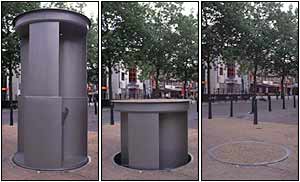 Will loos such as this stem the tide of street urination? It is 150 years since the first public toilet was opened in the UK. Yet in many parts of the country, this most appreciated of civic facilities is in danger of extinction. Those who have ever been caught short while out and about will know that it can be quite a challenge to find a convenient place to spend a penny.
Concerns that loos have become blighted by drug users, vandals and other undesirables have contributed to the problem. Yet the lack of facilities is becoming more than just a public inconvenience - it is dragging down our urban environment, according to some experts. The problem seems to be that without public loos, people are increasingly turning to the street itself as a toilet. This can lead to corroded buildings and health hazards. Anecdotally at least, incidences of public urination are on the rise.
Dr Greed is concerned at the lack of facilities available, particularly for women. "Some local authorities think the only decent public toilet is a closed public toilet. Yet free and easy access to a public toilet is a fundamental human right." Eroding landmarks While some local authorities may prefer not to encourage the public passing of water, many realise that it is better to collect fluids than allow late-night revellers to pee as and where they please.
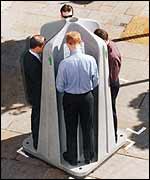
For uric acid passed by those waiting for night buses in Trafalgar Square has begun to erode the stone walls of the National Gallery. The council has installed 12 temporary urinals, two fixed urinals and, later this year, will open two telescopic urinals that will rise out of the pavement on Friday and Saturday nights. Councillor Mark Paige lays much of the blame on late-night revellers. But although it is an offence to urinate in the street, he says that enforcing this is difficult. "People have no inhibitions when they come out of pubs and clubs in the West End. It's quite astonishing to see how they treat the area but we hope that installing urinals will make a big difference." Behind the times John Alderin, of the Swedish company Danfo, says that local authorities account for nine-tenths of his business in the UK.
"Street fouling seems to have got worse - or at least people are aware of it more," Mr Alderin says. "Ten or 15 years ago, people didn't stand in the street, they went behind a hedge." Richard Chisnell, the director of the British Toilet Association, sees portable and pop-up loos - and fines for people who don't use public toilets - as a way forward. "We can either return to medieval days when people urinated in the streets or we can try to tackle the growing problem."
By this yardstick, she has found that Europe lags far behind countries in Asia such as Malaysia, Hong Kong and South Korea. "While Britain's toilets are in decline, there is a 'restroom revolution' going on in the Far East. The mayor of a major city in northern Japan said that provision of good public toilets is as important an investment as a new airport." Perhaps the novelty of new-fangled loos will encourage more Britons to use public toilets - at present just one-third are thought to venture into them. No wonder the streets are awash. | | See also:  14 Aug 02 | England 03 Jul 01 | UK 13 Feb 02 | UK Internet links: The BBC is not responsible for the content of external internet sites Top UK stories now: Links to more UK stories are at the foot of the page. | |||||||||||||||||||||||||||||||||||||||||||||||||||||||||||||||||||||||||||||||||||||||||||
| |
|  E-mail this story to a friend E-mail this story to a friend |
| |
| Links to more UK stories |
| | | ||
 | ||||
 | | Back to top
| ||
| ---------------------------------------------------------------------------------- To BBC Sport>> | To BBC Weather>> | To BBC World Service>> ---------------------------------------------------------------------------------- © MMIII | News Sources | Privacy |