|
 |
 | | | | | | ||||||||||||||||||||||||||||||||||||||||||||||||||||||||||||||||||||||||||||||||||||||||||||||||||||
| | | You are in: UK | ||||||||||||||||||||||||||||||||||||||||||||||||||||||||||||||||||||||||||||||||||||||||||||||||||||||
|
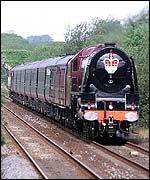
| | Thursday, 13 June, 2002, 11:10 GMT 12:10 UK Jubilee tour diary: Wales walkabout The BBC's arts and media correspondent Nick Higham is following the Queen on her Jubilee tour of the UK. This is the 11th in a series of dispatches from around the country. Tuesday 11 June The Queen is not used to sharing the limelight but at the start of her three-day tour of Wales there is another female jostling for attention. She is the Duchess of Sutherland, a handsome 74-year-old who has just had a �500,000 facelift and is attracting more admiring oohs and aahs than Her Majesty as she puffs into Llanfair PG on Anglesey, the town to which a mischievous Victorian Welsh language enthusiast gave the longest name in Britain. The Duchess is a Princess Royal Class steam locomotive built for the London Midland & Scottish Railway in 1938, and today she is pulling the royal train after three years' restoration work, largely funded by the lottery, largely carried out by volunteer enthusiasts. Serendipitous spirit Ostensibly she is on royal duty today to mark the 160th anniversary of the first royal journey by train, when Queen Victoria went from Slough to Paddington. But really she is out today because (in the serendipitous spirit that marks many of these royal visits) it seemed like a good idea to the men who restored her and to the freight train company EMS, which operates the royal train, to lay on the first steam-pulled royal train for 35 years.
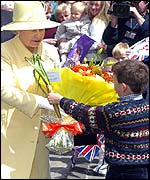
It is appropriate too. Steam trains are tourist attractions and today's visit is largely devoted to tourism, on which this corner of North Wales is largely dependent. From Llanfair PG the Queen is off to Beaumaris Castle, last of the "iron ring" of massive castles built in the late 13th century by Edward I to keep the Welsh in check (though Beaumaris was never finished). And she is having lunch at another castle, this time a Victorian replica called Penrhyn, with representatives of the tourist industry from across Wales. As it happens tourism here, which was badly hit by last year's foot-and-mouth epidemic, is doing rather better in 2002. And the Queen herself has had a hand in that: local hotels and attractions report their busiest few days in ages over the recent Jubilee Weekend. Today's tour has its more formal elements too - in particular a service of thanksgiving (to mirror those in Edinburgh, Belfast and St Paul's in London) at Bangor Cathedral. The bilingual service (English-speakers have helpfully been supplied with a phonetic crib of the words to the Welsh hymns) begins with the "English" national anthem, God Save the Queen, and ends with the Welsh, Land of Our Fathers. Walkabout And there is a sermon by Dr Rowan Williams, Archbishop of Wales and Desmond Tutu's hot tip to be the next Archbishop of Canterbury. After the service the Queen goes on a brief walkabout. There are a few hundred people lining the street, but the numbers are small compared to those in areas like South West England.
There is a little polite applause but not much of the cheering and vigorous flag-waving that has greeted her elsewhere. The reason seems to be indifference on the part of many in this strongly Welsh-speaking, Welsh nationalist part of the world to what is seen as an English monarchy. In this respect north west Wales is like Scotland. Here too there is resentment in some quarters at English incomers, who are accused of pricing locals out of the housing market by buying country cottages and retirement homes. Nervousness at how she will be received has perhaps influenced the decision by the police and the Palace not to extend her walkabout down Bangor's narrow main street, where the prospect of the Queen trapped between the tall houses has raised security fears.
Just down the coast the Royal Borough of Caernarfon is also smarting because the Queen has left the town out of her itinerary. It was there in Caernarfon Castle that Prince Charles was formally invested as Prince of Wales in 1969. The town had high hopes of the benefits that might flow from its royal connection - hopes that for the most part have not been fulfilled. At the end of the day the Queen meets up again with the Duchess at Llandudno Junction. She is presented with a replica of the engine's headlamp, complete with royal crown, by Brell Ewart, chairman of the Trust that restored her. And she meets the engine's crew, three EMS drivers old enough to have worked the steam engines of yesterday: driver Bob Morrison, fireman Bob Hart and "traction inspector" Gareth Jones, there to make extra sure that nothing goes wrong. And so, with much wheezing and panting and chugging, the train sets off to spend the night in a siding somewhere near Chester, and several hundred spectators (most of whom you suspect have come to see the Duchess, not the Queen) disperse happily along the North Wales coast. | |
See also:  06 Jun 02 | UK 11 May 02 | UK 14 May 02 | UK 24 May 02 | Scotland 25 May 02 | Scotland 25 May 02 | Scotland 26 May 02 | Scotland 27 May 02 | Scotland Top UK stories now: Links to more UK stories are at the foot of the page. | ||||||||||||||||||||||||||||||||||||||||||||||||||||||||||||||||||||||||||||||||||||||||||||||||||||
| |
|  E-mail this story to a friend E-mail this story to a friend |
| |
| Links to more UK stories |
| | | ||
 | ||||
 | | Back to top
| ||
| ---------------------------------------------------------------------------------- To BBC Sport>> | To BBC Weather>> | To BBC World Service>> ---------------------------------------------------------------------------------- © MMIII | News Sources | Privacy |