
|
 |
 | | | | | |||||||||||||||||||||||
| | You are in: UK | |||||||||||||||||||||||||
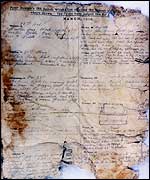
 | | Friday, 29 March, 2002, 07:21 GMT Diary of Scott's expedition restored 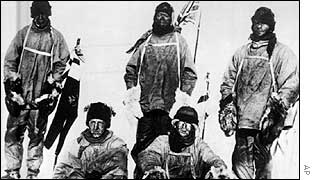 Scott with his men on the fatal Antarctic trip A diary scribbled on pages of a magazine by a crew member of Captain Scott's ill-fated 1912 expedition to the Antarctic sheds light on the explorer's final voyage. The fragile notes, encrusted in penguin droppings, were discovered yards from Scott's hut, 90 years after his death. It has been painstakingly restored by British student Kirsten Elliott using plastic protective sleeves in a lab in New Zealand.
Written by an unknown crewman, the diary records hardships encountered by the sailors on board Scott's ship the Terra Nova. He logs day-to-day chores, including looking after the dogs used to drag the explorers' equipment across the frozen landscape and the spectacle of officers, stripped to their underwear, washing their own clothes.
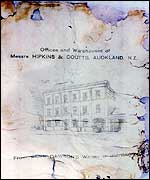
One diary entry read: "Very little wind, ship still rolling badly. In the dog watch a lot of washing clothes, officers flitting around in loin cloths doing their own washing, & fishing over the side for specimens." The diarist used a 1910 magazine produced by Scottish distillers, Dawson's Whisky Company, to write on. Pictures of the document have been released for the first time to coincide with the 90th anniversary of the last diary entry in Scott's own record of his fight to beat a team of Norwegian explorers to the South Pole. The diary was found last summer and is stored at the Antarctic Heritage Trust in Christchurch, New Zealand.
Miss Elliott, a 26-year-old conservation of fine art student at Northumbria University, was responsible for cleaning the document and stabilising the pages so they could be analysed by historians. She said: "The magazine was in a terrible state. It was found buried in an ice pack outside Scott's hut. "The Antarctic weather conditions left the magazine in an extremely fragile state. "Seasonal ice melts and re-freezing caused severe damage to the pages, which were dirty and ice damaged and the paper was badly cracked and splintered.
"The magazine had been frozen, buried and covered in penguin droppings for over 80 years. "The texture of the paper was one of the strangest things I've ever felt - it was fabric-like and spongy, which is unusual when working with paper, which generally becomes brittle with age. "One theory is that the water managed to get between the paper fibres, and as the magazine froze, the expansion of the water pushed the fibres apart." | | See also:  Internet links: The BBC is not responsible for the content of external internet sites Top UK stories now:  Links to more UK stories are at the foot of the page. | |||||||||||||||||||||||
|
Links to more UK stories |
 | | ^^ Back to top News Front Page | World | UK | UK Politics | Business | Sci/Tech | Health | Education | Entertainment | Talking Point | In Depth | AudioVideo ---------------------------------------------------------------------------------- To BBC Sport>> | To BBC Weather>> ---------------------------------------------------------------------------------- © MMIII|News Sources|Privacy  |





 E-mail this story to a friend