
|
 |
 | | | | | |||||||||||||||||||||||||||||||
| | You are in: UK | |||||||||||||||||||||||||||||||||
 | | Thursday, 21 March, 2002, 15:20 GMT Muddle over witness payments 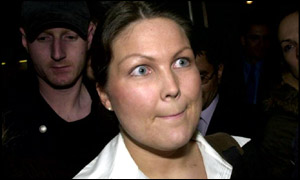 Amy Gehring sparked a media maelstrom
Did newspapers break the rules when they offered money to young witnesses in the recent trial of Amy Gehring for stories about their dealings with the supply teacher ? Not according to the Press Complaints Commission. It has concluded payments offered by five newspapers - the Daily Mail and Mail on Sunday, News of the World, Sunday Mirror and Sunday people - were justified and were not in breach of the newspapers' voluntary code of practice. Miss Gehring was acquitted last month on charges of indecently assaulting under-age pupils. But the commission's adjudication won't lay to rest the argument about whether such payments need to be banned by law.
Earlier this month the Lord Chancellor's department announced it was planning to make it a crime for news organisations to offer payments to witnesses in criminal trials. The department said payments could encourage witnesses to exaggerate their evidence or could prejudice juries. The Lord Chancellor is seeking responses to his proposals by the end of May. Drafting legislation The PCC's director, Guy Black, says the Gehring adjudication will form a major part of the commission's response. "If anyone can show that the administration of justice is at risk from payments then we'll happily co-operate in drafting legislation," he says. "But that case hasn't been made out. From our point of view the code has been working since it was tightened up after the Rosemary West case seven years ago, and Gehring underlines that."
But even that case would not have been caught by the proposed new legislation - because at the time money was offered no trial was in prospect. The Lord Chancellor's department is unabashed by the commission's latest adjudication. It is also in something of a muddle. New offence A spokesman says the department still believes the Gehring case is an illustration of the need to outlaw payments, if for no other reason than that payments can affect jurors' perception of a witness's credibility. But in fact the proposed new offence, as currently framed, would not have prevented the offers of payment to Gehring trial witnesses any more than the newspapers' code of practice. That suggests that if the department is serious about its plans it will have to toughen up its proposals. One way they could be tightened is suggested by Clive Soley, the Labour MP who has long campaigned for tighter controls on the press and who asked the commission to look into the Gehring payments in the first place. He says he has no problem in principle with newspapers paying witnesses, and he accepts that the payments in this case didn't breach the existing rules. No approaches But he thinks that means the rules need changing. "In my view we ought to have a rule saying that no approaches can be made to a witness before the trial is over, and preferably before sentencing. "That would give everyone a cooling-off period." He also thinks the newspapers have been disingenuous in arguing that the disclosures about Amy Gehring's past were in the public interest. "The letters of defence from the newspapers and the PCC's adjudication don't once mention the word 'sex'," he says. Responsibility to children "The newspapers could have had a perfectly proper discussion about the problem of supply teaching - but this had nothing to do with that really. "This was all about who screwed who." And he believes newspapers should take more responsibility for deciding whether to publish interviews with children. This should especially apply to sensitive matters like sexual relations, rather than relying on the fact that the children's parents have given consent. "I don't like this assumption that just because the parents say it's OK it's alright for the media to publish," he says. | | See also:  Internet links: The BBC is not responsible for the content of external internet sites Top UK stories now:  Links to more UK stories are at the foot of the page. | |||||||||||||||||||||||||||||||
|
Links to more UK stories |
 | | ^^ Back to top News Front Page | World | UK | UK Politics | Business | Sci/Tech | Health | Education | Entertainment | Talking Point | In Depth | AudioVideo ---------------------------------------------------------------------------------- To BBC Sport>> | To BBC Weather>> ---------------------------------------------------------------------------------- © MMIII|News Sources|Privacy  |


 E-mail this story to a friend