
|
 |
 | | | | | ||||||||||||||||||||||||
| | You are in: UK | ||||||||||||||||||||||||||
 | | Wednesday, 13 March, 2002, 12:07 GMT Public sector pay lags behind police 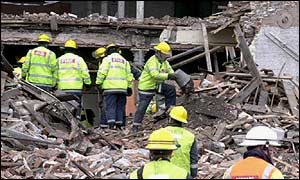 Firefighters say they face as many dangers as police Rates of pay for nurses, teachers, firefighters and even doctors compare unfavourably to those in the police, unions argue. Police are rallying in London on Wednesday over planned reforms to pay and conditions, but many other public sector workers believe they are in a worse state. Mick Shaw, a member of the Fire Brigades Union national council, told BBC Radio 4's Today programme firefighters face a similar level of risk to police, but received lower pay.
"I'm on that rate - it works out with our London weighting at just over �25,000 which is the same as a police officer gets after 18 weeks' initial training," he claimed. "Firemen start on just �17,000." In fact, the salary for a London-based police officer is �25,953 after 18 weeks, according to the Metropolitan Police website. Firefighters also miss out on some of the perks offered to police in the capital such as free travel passes and interest free loans to buy houses in high price areas. "The kind of risks the firefighters face must be at least similar if not higher and we do receive considerably less than the police currently get." Recruitment crisis Many public sector workers might be jealous of the steady increase in police pay which has increased by more than inflation every year since 1979. Teachers who face a recruitment crisis in south-east England and elsewhere, also face disparities. Barry Forsett, head of NUT salaries department, said the highest allowance for teachers in London is just over �3,100 while the top rate for the police is about �6,100.
"To be a teacher you have to be a graduate and you have to do professional training on top of that. "In the police you can go in and after a short period of training you go straight in at the starting salary." Nurses also face four years of training before they start work at more than �3,000 less than a starting police officer. Even junior doctors start on less than a police constable. 'Danger money' How to tackle archaic working conditions in the police has vexed successive governments, anxious not to appear anti-police. Times columnist Simon Jenkins said there was sympathy for the unneccessary paperwork officers were made to fill in, but "danger money" should not be paid to office-bound officers. "It's not dangerous sitting in an office block, it just isn't. It's absurd.
But the political pitfalls of efforts to changes this are well-known by Commons Home Affairs Committee chairman Chris Mullin. "All previous home secretaries have had difficulty persuading the police that some changes are needed. "There is no doubt they are relatively well off compared with other similar professions." But Police Federation chairman Fred Broughton said officers everywhere in the country were facing much higher workloads but were undervalued. "To start talking about police officers not walking the beat is a nonsense." | | See also:  Internet links: The BBC is not responsible for the content of external internet sites Top UK stories now:  Links to more UK stories are at the foot of the page. | ||||||||||||||||||||||||
|
Links to more UK stories |
 | | ^^ Back to top News Front Page | World | UK | UK Politics | Business | Sci/Tech | Health | Education | Entertainment | Talking Point | In Depth | AudioVideo ---------------------------------------------------------------------------------- To BBC Sport>> | To BBC Weather>> ---------------------------------------------------------------------------------- © MMIII|News Sources|Privacy  |


 E-mail this story to a friend