
|
 |
 | | | | | | ||||||||||||||||||||||||||||||||||||||||||||||||||||||||||||||||||||||||||||||||||||||||||||||||||||||||||||||||||||||||||||||||||||||||||||||||||||||||||||||||||
| | | You are in: Talking Point | ||||||||||||||||||||||||||||||||||||||||||||||||||||||||||||||||||||||||||||||||||||||||||||||||||||||||||||||||||||||||||||||||||||||||||||||||||||||||||||||||||||
|
| | Wednesday, 14 August, 2002, 10:20 GMT 11:20 UK On-the-spot fines: Will they work? 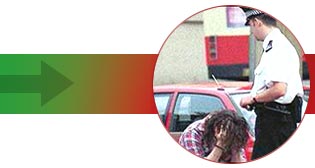 On-the-spot fines for anti-social behaviour are introduced this week in three pilot areas. Police officers will be able to issue �40 and �80 fixed penalties for offences such as using threatening behaviour, being drunk and disorderly and making hoax 999 calls. Adult offenders will be able to pay the fines by post. If they deny the charge, they can elect to go to court for a full trial. If they fail to pay the fines, police can prosecute them for the original offence. The scheme will run in the West Midlands, Essex and Croydon in south London. North Wales will begin the pilot in September. If the one-year trials are successful, it could be rolled out nationwide. Will on-the-spot fines help to reduce anti-social crime? Or will it cause confrontation on the streets? This debate is now closed. Read a selection of your comments below. Your reaction
John Brownlee, England It's another ridiculous idea. If arresting someone involves four hours of police paperwork, why don't they reduce the amount of paperwork ? What on earth are they writing for four hours? The suspect's life story? Also what stops a drunk from giving a false name and address? Despite occasional problems I have an inherent trust for the police, despite coming from an ethnic minority. I feel that their time is often wasted on getting trouble-starters to and through the courts when they could be on the streets providing the service they have signed up to provide. As long as there is a robust complaints system set up to deal with this scheme independently, I'm all for it. I think it's a good idea in principle, but I can't understand this whole rich/poor social divide issue. If you can afford to get drunk, you can afford to pay when you get nasty with it - end of story. What is the point of fines if there is never anyone nearby to enforce them? These louts and yobs have ultimate rule of London's streets with their destructive and violent behaviour, and until they are completely removed nothing will change. It's about time the government stopped fooling us with their token crime prevention initiatives and do something substantial to put the law back into the hands of the victims and not the criminals. These people know they can get away with it and they will.
Bharat Mehta, UK All this is doing is trying to save court time by turning police into "Human Traffic" wardens issuing tickets for bad behaviour instead of bad parking. What will the yob do while the ticket is being issued? Stand around being penitent? This idea is about as silly as they get. The only workable solution is to build more prisons, have longer sentences to keep the thugs off the streets. But that is either too sensible or too expensive to consider. Well, the civil liberties groups are moaning again. Have any of them been out in Croydon on Saturday night? These louts are a major problem and need to be hit where it hurts - in their pockets. We won't know if the scheme will work until it's tested but for my money the fines don't go far enough. �100 fines would be more effective and certainly far more should be demanded for hoax 999 calls.
Stuart A, UK A distinction must be realised between genuine louts with a propensity for violence and those returning home after a few too many. Students, in particular, are often picked on by police in this way. Why do we insist on making such a big issue about the lesser issues such as drunk and disorderly? Why not put more effort into stopping young children disappearing and people being raped and murdered? Surely these are much more important issues that we should be dealing with!
JL, UK Just another piece of nouveau fascism taking us closer to New Labour's grand nirvana: a selectively repressed police state. Utterly ridiculous, ignore at your children's peril.
Graham, US/UK Spot fines won't work. Instead, confiscate their clothes on the spot. That WILL work. Will those paying the fine still have a criminal record?
Alex, UK If I was given the choice of a ticket for disorderly behaviour or being taken down the nick to be booked I would definitely choose to have a ticket. This appears to be a modern method of the old 'clip round the ear' mentality that worked so well 30 odd years ago. However, it needs to be implemented firmly - not ignored like riding a bicycle without lights - and I wish the police every success. Is this another rule intended to bring us in line with Europe? Specifically, those French police who stop UK cars for 'speeding', then offer them the option of an on-the-spot fine to continue when of course, the word "receipt" is not part of their understanding..? They never enforce the rule against motorists who use mobile phones while driving and dogs fouling in public places. Have you ever seen a cyclist being pulled over for cycling on the payment? The law in this country just cannot be enforced as it should be. This is why the UK is becoming a lawless society. What a palaver of paperwork and appeals for the yobs to exploit - no doubt funded by legal aid. They should be given a clip round the ear there and then!
Gary, England Does anyone know how they deal with the problem in Singapore which is a well ordered society? I welcome the new fines, I think they should be related to income though because �80 would not be enough for rock stars or actors. First step - lock up the lawyers. Second step - lock up the social workers and psychiatrists. The law sounds a good idea but the lawyers and psychiatrists will claim their client was victimised by the police, or is from a broken home, and another remedy to the yob culture bites the dust. Back to the drawing board, guys, 9 out 10 for initiative, 1 out of 10 for practicality.
Alex Duggan, UK It is an interesting idea, but the problem is not the yobs - it is the culture of hammering back three or four pints at 11pm prior to being kicked out of the pub. If pubs closed at staggered times, this yob culture would be less of an issue. As long as yobbish behaviour is still being glorified in the media, people will aspire to it as an ideal, instead of seeing it as the inconsiderate nuisance it really is. Fines alone will not work, especially if they aren't properly enforced, there needs to be a comprehensive review of our society's values.
Dave, UK What's to stop the offender giving a false address? Besides, I imagine most drunks are not exactly from the richest section of our society. John Collins: If people are rich enough to get drunk, then they are certainly rich enough to pay a fine if they are charged with behaving in a disorderly manner. Excellent idea, no chance it will work! I live in Leigh on Sea, Essex where it will be tested. The area is a very busy nightspot and I almost fell over last weekend coming out of a pub - not because I was drunk but because I saw a bobby on the beat! On top of this the police have enough hassle with people who are actually doing harm without filling in paper work for everyone who slurs their speech! This is a trial and it's certainly worth a go. I would be inclined to double the penalty. As for not being able to pay; if they can't - how about compulsory community service? People behaving anti-socially, who like to believe they are the only ones that matter and that the rest of society owes them something, should be "encouraged" to put something back into society.
John Cooper, UK As long as such offences can be proven without a doubt, this is a good idea. It could free up police time to pursue serious criminals, and hopefully save the taxpayer money. It is similar to the current fixed penalties for traffic offences. You are informed by letter that you have been caught breaking a traffic law, and you are given a time limit to pay the fine. Once the fine is paid and your licence is endorsed, you have no further dealings with the justice system. However, it is easy to prove with cameras that your car (with a traceable number plate) was speeding at a specific time and place. It could be more difficult to prove that a drunk who couldn't remember his own name was being abusive to a police officer. I come from a country where on-the-spot fines are the norm. Police have the power to stop you and fine you if deemed necessary. I really cannot see anything wrong with it. If we live in a society with rules, they have to be applied, respected and indeed enforced. If not respected, the offenders must pay and seems to me a bit silly to have to rely on a judge in order to punish someone who is drunk (judges should spend their time in more constructive way). If they cannot pay then the money should be deducted from their wages under the form of taxes (again applied in most of the other countries in Europe) if there is not an income then few days spent in a cell or community work will help the offender to get his ideas a bit clearer on how society works. There are already assaults against traffic wardens handing out parking tickets to sober motorists. Add alcohol to the equation and I think there will be a sudden rise in assaults on police officers handing out tickets to drunks. Sounds like a money-making scheme to me, add to that the way the police could use positive results for spot fines to distort crime clear-up statistics along with making them judge and jury (a role they already see themselves as fulfilling) then this is a recipe for disaster. If you have ever watched the usual tricks of fare dodgers on the trains you will know how this one works: tell the officer you have no money, then give them fake contact details (or even those of a "friend"). The only alternative is to drag the miscreant into the police station, demand ID and keep them in the cells until their identity is confirmed - I can really see that happening. These sorts of fines are - to quote Blackadder - about as effective as a cat-flap in an elephant house. If individual police have the power to make decisions normally reserved for magistrates, then it is certainly open to abuse. In theory, the police can fine someone they don't like the look of - it'll be their word against ours. I do hope it works though, our streets could do with a clean up, I'm sure everyone has felt intimidated at some time, by gangs of youths congregating on badly lit street corners, but then teenagers rarely have ID on them, so providing a fake name and address would be easy, surely? In the US, where I am a prosecutor, we allow defendants charged with minor crimes and traffic offences to waive their appearances in court and pay statutorily-fixed fines on a regular basis. Why does it matter whether a defendant who wants to admit guilt pays the fine in front of a judge or in front of a clerk? The problem with such an idea is that anti-social behaviour is entirely subjective. What may be high spirits to one person may be seen as anti social by another. Surely it would be a better idea to arrest people who have committed a crime rather than trying to dictate what acceptable behaviour should be. After all many people get very drunk and cause no problems at all, I count myself in that group. How can this system be enforced? It is not a legal requirement in the UK to carry any form of ID so it would be very easy to give a false address and not pay the fine. Fining people for being drunk and disorderly is only going to create more resentment to authority without dealing with the causes. And of course this law will no doubt be enforced at Ascot and Glyndbourne as well as the run down neighbourhood local!
Mel, London Why is there so much concern at police imposing on-the-spot fines? Other countries do it. In the UK, traffic wardens already do it for illegal parking. Much worse are all the private clamping companies, who charge typically �50-150 to release vehicles with no come back. At least the proposals allow the police to do something about yobbishness at the time, and there is still the appeal process through the courts.
Dan, UK Dan UK, seems to think that the only people against this idea are left-wingers. Well as a Libertarian minded Conservative voter, nothing can be further from the truth. It's all very well this government bringing out a tough on crime policy, but not when it won't work and will curtail our civil liberties. This goes so much further than left-wing and right-wing stereotypes. This is an ill thought out plan and needs to be looked at properly before implementation. Oops! It's too late for that, now. It's already gone to trial in these three areas... Fines, on the spot or otherwise, do not stop people breaking the law. As others have already said, those carrying no means of payment, and the poor, will not be deterred from breaking the law. The real problem goes deeper. I would suspect that many law breakers do so, because they feel they are outside the law, and outside society. They have no stake and no voice. If we can include more people in society, democratically and economically, perhaps we'll see a reduction in crime. On a Friday or Saturday night police in Croydon are far too busy chasing perpetrators of the increasing numbers of shootings and stabbings that are now occurring on a weekly basis. Shouldn't it be a priority to increase police presence to deter these far more serious crimes instead of scouting for drunks just to increase their revenue?
Martin, UK Martin UK raises an interesting point without realising it. Although I think too much is made of human and civil rights, will a drunk and disorderly individual be able to understand that they are being fined? We ask them if they understand their rights on arrest, but can the issue of capability to understand be called into question in a court appeal? Surely if the streets where these "louts" are misbehaving were already being patrolled by the police that would in itself be a deterrent to anti-social behaviour? The crimes listed are too subjective and unprovable, and will only end up as your word against the police. Also, what happens if you're seen being drunk by 20 policemen? Would you get fined 20 times for the same offence? To answer Martin, UK - no you won't get 20 fines, the offence is only committed once. Also it is not as easy as people think to give false names. These sorts of people have probably come into contact with the authorities in the past and so will find hiding behind false details more difficult. As for only carrying cash and no cards when you go out on the beer so that you can't be identified: go for it. A drunk with a pocket full of notes is one of the easiest robbery targets a mugger can hope for. Why is it that in Britain we are more interested in treating the symptoms than the cure? Why not invest in teaching people respect for others, the law and the fact that discipline and good behaviour are not dirty words? What is going to happen when someone is unable to pay these fines through lack of funds, despite being able to afford spending all day in a pub getting drunk? I fear that this will lead to abuse and become a means of intimidation in the same way as the hated "sus" laws 20 years ago.
Chris B, England I predict failure within six to 12 months, on the basis that all crooks automatically deny everything and always protest their innocence. Don't think it will work. It will go the same way of fining cyclists who ride on pavements - not implemented!! It will be interesting to see in say 12 months time how many fines have been handed out and how many have actually been paid. Fines are a good idea, but will they work? Some people will laugh at it and go on being anti-social despite a fine. It is far better to back them up with a prison sentence or community service on the second strike then at least there is a deterrent effect and a warning to the person doing it to make them face the consequences of their actions. Again we see the penalty notion as opposed to the education approach. It'll be a great way to raise money, and we all know who the police will target, leading to even more allegations of racial intolerance. Will these fines be applied retrospectively? If so we can look forward to the sons of the prime minister, the foreign secretary, and the Prince of Wales all coughing up �40 for their recent misdemeanours. I honestly think this plan might work because of nature of the British people. Michael, US - nice sentiment but I don't think you've ever seen the centre of Bristol at 2am on the Sunday morning, or the centre of any British city for that matter. I hope it works but I can see the courts having a nightmare!! Will it cause a drunken thug to think twice before lobbing a beer bottle at a passing police car? Probably not. Will it cost less in public resources to punish him? Yes. Case closed. I find drunks a pain, but there are many other groups that I find just as repellent - on-the-spot fines should be extended to all the other anti-social elements. | | Internet links:  The BBC is not responsible for the content of external internet sites Top Talking Point stories now: Links to more Talking Point stories are at the foot of the page. | ||||||||||||||||||||||||||||||||||||||||||||||||||||||||||||||||||||||||||||||||||||||||||||||||||||||||||||||||||||||||||||||||||||||||||||||||||||||||||||||||||
| |
|  E-mail this story to a friend E-mail this story to a friend |
| |
| Links to more Talking Point stories |
| | | ||
 | ||||
 | | Back to top
| ||
| ---------------------------------------------------------------------------------- To BBC Sport>> | To BBC Weather>> | To BBC World Service>> ---------------------------------------------------------------------------------- © MMIII | News Sources | Privacy |





