 | BSP supporters see their party set for government 
|
India's low-caste Bahujan Samaj Party (BSP) has swept to a historic victory in assembly elections in the key northern state of Uttar Pradesh. With all but a handful of results declared, the BSP had won 202 of the 403 seats to allow it to form its own government, Indian media reports said.
It is the first time since 1991 that any party in the state has done so.
Uttar Pradesh is India's most populous state and has long been its most politically influential.
|  I thank people of all castes and communities who supported my party I thank people of all castes and communities who supported my party  |
The BBC's Sanjoy Majumder in Delhi says the result represents a major setback for India's mainstream political parties who faired poorly in polls which observers believe could help determine India's political future.
He says many believe it is significant that BSP leader Ms Mayawati - a fiery politician from the poor, deprived Dalit (formerly untouchable) caste - has managed to spread her political appeal and that it may not be long before India votes in a lower caste prime minister.
Celebrations
Jubilant, flag-waving BSP supporters gathered on Friday outside Ms Mayawati's residence in Lucknow, the capital of Uttar Pradesh.
 Mayawati is a Dalit, at the bottom of the caste system |
Dancing party supporters set off fire crackers and celebrated with sweets.
Ms Mayawati now begins her fourth term in office, but hers will not this time be a coalition government.
"I thank people of all castes and communities who supported my party to achieve this overwhelming victory," she told a news conference.
Outgoing chief minister Mulayam Singh Yadav had earlier admitted defeat and resigned. His Samajwadi Party came a poor second, far behind the BSP.
India's two main political parties - the governing Congress and the main opposition Bharatiya Janata Party (BJP) - also did very badly.
Both have been on the decline in Uttar Pradesh in recent years. The poor Congress showing came despite a high-profile campaign by Rahul Gandhi - the fourth generation of the famous dynasty.
 Former Chief Minister Mulayam Singh Yadav has admitted defeat |
Ms Mayawati's support base is mostly with the lower caste and poor communities who form a significant percentage of the Uttar Pradesh electorate.
The elections were held in seven phases over a month for logistical reasons. None of the phases had a turnout higher than 50%.
The vote will also be remembered for having seen no significant violence, unlike in the past.
Major problems
Caste and religion have been dominant factors in politics over the past two decades in Uttar Pradesh, one of India's poorest states.
Uttar Pradesh is also plagued by corruption, and lags behind other parts of India in areas like development and health.
Because of its sheer size and numbers, Uttar Pradesh, commonly called UP, holds an important place in the Indian political system.
More than 49 million people were eligible to vote at nearly 50,000 polling stations in Uttar Pradesh, watched over by thousands of police and paramilitary troops.
The state has more than 175 million inhabitants. It sends 80 MPs - the highest number in India - to the federal parliament, more than any other state.
It has produced most of India's prime ministers, including the Nehru-Gandhi dynasty.


 One-Minute World News
  News services


 E-mail this to a friend
  Printable version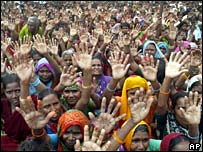
 Enlarge Image


