By LR Jagadheesan
BBC News, Madras |

 | Tamil Nadu was the worst affected state 
|
Prayers and protests marked the second anniversary of the Asian tsunami in the south Indian state of Tamil Nadu, the worst-affected state in the country. About 8,000 people were killed and nearly a million were left homeless.
Elsewhere Sri Lanka declared a national safety day, as survivors and mourners across the region lit candles, visited graves and held moments of silence.
A magnitude 9.0 quake triggered the Asian tsunami on 26 December 2004, claiming almost 250,000 lives.
In Tamil Nadu, people from the fishing community who live in the 370 villages lining the coastline were worst-hit by the giant waves.
'Dingy' shelters
Remembering the disaster, people held multi-faith mass prayers and lit candles while fishermen refrained from going out to the sea.
 Tsunami survivors were among those who held remembrance rallies |
On Monday and Tuesday organisations representing the tsunami survivors held demonstrations in the capital Madras (Chennai) to demand permanent accommodation.
Government statistics reveal that two years on only 35% of permanent shelters have been completed.
As a result, thousands are still living in "dingy temporary sheds infested with mosquitoes and rats" which is affecting their health and children's education.
Even those who have been allotted permanent shelters are dissatisfied and say that the houses lack basic amenities as electricity, drinking water and sanitation.
Many fishermen have refused to move to newly-built colonies as they say the distance from the sea is hindering their livelihood and routine.
New boats
But the rehabilitation has not been uniform across the state. Whereas all survivors have been given permanent shelters in Cuddalore district, only 12% have moved into their new homes in the nearby Nagapattinam district.
Unavailability of land along the coastline, suitable for fishermen, and lack of coordination between government, NGOs and local communities are said to be major reasons hampering speedy rehabilitation.
But some aspects of the rehabilitation process have received widespread appreciation.
Fishermen who lost their livelihoods have been provided with fishing nets, boats and other amenities while the women received vocational training and guidance from self-help groups.
Educational facilities for children have seen the most improvement with NGOs and projects, many funded by multi-national companies, providing good quality and in some cases English-medium education.


 One-Minute World News
  News services
 E-mail this to a friend
  Printable version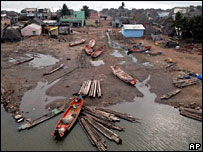
 Enlarge Image


