 | The protests have brought the country to a halt 
|
Normal life in Bangladesh has been paralysed for a second day by a blockade enforced by the Awami League party and its allies. They want the top election commissioner to resign, accusing him of favouring the outgoing government led by the Bangladesh Nationalist Party (BNP).
The BNP handed over power to an unelected caretaker government in late October which will oversee the vote.
At least two people died in political violence on Tuesday, police say.
Political say the two activists were killed when a bus carrying supporters of a rival political group drove at them in the south-eastern district of Chittagong.
Roads blocked
Fighting also broke in the city of Chittagong itself. In the northern town of Bogra at least 20 people were injured in clashes between BNP and Awami League supporters.
 The protests have meant travel between towns is almost impossible |
In Dhaka, schools and shops remain closed. Thousands of rickshaws replaced other vehicles as a result of the transport blockade.
The BBC's Roland Buerk in Dhaka says the blockade is having a serious effect on the economy.
Travel between towns and cities is all but impossible. Roads and railways are blocked.
All traffic to and from the main port at Chittagong has been stopped.
'Rig the polls'
The owners of garment factories, the country's main export, say they are losing at least $70m a day.
The Awami League and its allies are enforcing the blockade in an effort to try and force Mr Aziz to go.
They accuse him of planning to rig the polls in favour of the outgoing government led by the BNP.
The country is being ruled by an interim administration headed by President Iajuddin Ahmed. Under the constitution, he cannot sack the chief election commissioner.
Members of the president's temporary cabinet met Mr Aziz on Monday.
Later they said a solution to the crisis might be found by Wednesday and there is widespread speculation that the chief election commissioner may resign or go on extended leave.


 One-Minute World News
  News services


 E-mail this to a friend
  Printable version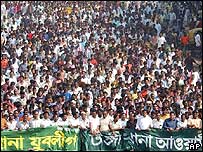
 Enlarge Image


