By Sanjoy Majumder
BBC News, Delhi |

 | The two countries have a long pending border dispute 
|
When Hu Jintao arrives in India on Monday it will mark the start of the first visit here by a Chinese president in a decade. It's a measure of how relations between the two Asian giants have been captive to years of mistrust, mutual suspicion and rivalry.
But a growing trade relationship between two of the world's fastest growing economies is challenging traditional mindsets and is encouraging vastly improved ties.
Trade between the two countries is expected to touch $20bn by next year - in the 1990s it hovered around the $250m mark.
Many view the economic relationship between the two as complementary rather than competitive.
While India has the resources to satisfy China's growing appetite for raw materials such as iron ore, steel and plastics fuelling its massive manufacturing industry, China can provide manufacturing expertise and investment in infrastructure.
Regional ambitions
Many Indian IT firms, the country's growth industry over the past decade, have already established offices in China.
But for two countries which have ambitions of being the unrivalled regional superpower, it is only natural that economics is often undermined by politics.
Indian industry complains that China needs to be far more transparent in its dealings - for instance, they argue that there are hidden subsidies in China allowing its products to be priced far lower than the competition.
There are also fears that China is flooding India with low-quality consumer goods - a fact that is illustrated vividly by a trip to any Indian market where Chinese-made clothes, furniture, electronic goods and even firecrackers are widely available.
 Hu Jintao's visit to India is the first by a Chinese president in a decade |
"But many of these goods are far lower in quality than what the Chinese sell to the West, including the United States," a top industry official says, refusing to be named. But China has its own concerns.
It says Delhi is blocking investment in areas such as ports and telecommunication, citing security concerns.
While India denies it discriminates against Chinese investment, a recent internal report prepared by the country's national security council argued for new legislation to monitor investment from countries which could pose a risk to national security, including China.
Dispute
India's relationship with China, however, also has a significant geopolitical dimension.
The two countries have a long standing border dispute and a recent statement by the Chinese ambassador in India, in which he said Beijing laid claim to the state of Arunachal Pradesh in north-east India led to a furious reaction from Delhi.
While the claim is not new, and India for its part claims a part of Kashmir under Chinese control, it certainly reopened old wounds and raised fresh concerns in Delhi.
India and China fought a brief war in 1962 with a decisive victory for the Chinese, an event which many Indians still view as traumatic.
But Delhi is also suspicious of China's relationship with its long-time rival Pakistan.
 Traders have welcomed the opening of the Nathu La pass in Sikkim |
Beijing and Islamabad share close military ties and there are suggestions that President Hu will announce a major nuclear deal with Pakistan during his visit to that country, immediately after his India trip.
That is something that will certainly not go down well in Delhi which cited the threat from China as its primary motive to declare its nuclear status in 1998 by carrying out a series of nuclear tests.
For its part, China is concerned about Delhi's growing ties with Washington especially the landmark nuclear agreement between the two allowing India access to civilian nuclear technology.
India is also wary of China increasing military and trade ties with a number of its neighbours.
Both countries are competing for influence in Burma and Nepal and the fact that the Tibetan government-in-exile is based in India is something that still annoys China.
The two sides also have differences over the Indian Ocean.
Despite this, many in India believe that it is possible and in fact important to do business with China.
At least one illustration of the seriousness with which India views its relations with its giant neighbour is the growing interest in Chinese language classes at its various universities and institutes.
The question is, how easily can Delhi bury the ghosts of its past.


 One-Minute World News
  News services


 E-mail this to a friend
  Printable version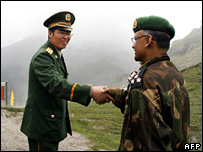
 Enlarge Map


