|
 |
 | | | | | | ||||||||||||||||||||||||||||||||||||||||||||||||||||||||||||||||||||||||||||||||||||||||||||||||||||||||||||||||||||||||||||||||||||||||||||||||||||||||||||||||||||||||||||||||
| | | You are in: South Asia | ||||||||||||||||||||||||||||||||||||||||||||||||||||||||||||||||||||||||||||||||||||||||||||||||||||||||||||||||||||||||||||||||||||||||||||||||||||||||||||||||||||||||||||||||||
|
| | Friday, 5 July, 2002, 14:58 GMT 15:58 UK Dhaka's row over radicals Could religious schools be fomenting extremism?
Bangladeshi Prime Minister Khaleda Zia has strongly denied opposition claims that her governing coalition contains members of parliament sympathetic to the Taleban and al-Qaeda.
It had offered America the use of its airspace when George Bush conducted his war against terror in Afghanistan. But the opposition says that two hardline Islamic parties within her four-party coalition have constantly spoken out against America and have even expressed support for al-Qaeda leader Osama Bin Laden. Anti-US feelings The arguments go to the heart of Bangladesh's future identity. The Islamic Unity Alliance (IUA) is one of the two hardline Islamic parties that are part of the coalition government.
"We consider an attack on one Muslim country to be an attack on all Muslim countries," said a spokesman, Fazlul Haq Amini, who is a backbench government MP. "We believe it is our religious duty to protest against George Bush and his European allies." Opposition sceptical Ever since Mrs Zia was sworn in as prime minister last year, the main opposition Awami League has attacked the make-up of her coalition.
Awami League spokesman Saber Hossain Chowdhury says there are MPs in the current ruling coalition who are sympathetic towards the Taleban. "There are perhaps even ministers in the current government who are sympathetic towards the Taleban. "This is a largely tolerant society, and we want to see Bangladesh continue on that line. "At the same time we cannot be like an ostrich burying its head in the sand." Identity crisis Ever since it was formed in 1971, many in Bangladesh's 130 million population have struggled over whether they are Bengalis first or whether their Muslim religion should take precedence in their lives. The editor of the English-language Daily Star newspaper, Mahfuz Anam, says that this identity crisis is behind many of the country's problems.
"The government has taken the position that Bangladesh is a land of religious harmony, and there's nothing happening in the country. "I think both these positions are extreme. "We definitely are not an extremist country - our religious tradition is one of tolerance - but that is not to say that there are no groups in Bangladesh which may be fomenting religious intolerance." Hindu 'persecution' Nowhere is this alleged intolerance more clearly seen than among members of the minority Hindu community.
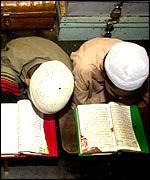
The Jammat-e-Islami social welfare minister, Ali Ahsan Muzahid, denies that there has been widespread persecution of religious minorities, or that his party sympathises with Osama Bin Laden. "You know that we have good relations with America and Britain and we want to maintain that in future also," Mr Muzahid said. "Islam always supports the punishment of terrorists and Islam never supports terrorism." 'Liberal' imams At the main training schools for Muslim clerics, or imams, in Dhaka, brief worship session are held before classes begin. The lessons seem to confirm Bangladesh's reputation as a moderate Muslim state.
There are 40,000 imams who have attended such institutions throughout the country. The Taleban and Osama Bin Laden are not even mentioned on such courses, says lecturer Mohammed Morshed Hossain. "This is a fundamentally and totally wrong attitude," he says. "I think that if somebody in the international community believes that Bangladesh is a Taleban nation, or a fundamentalist nation, they're just giving a wrong statement. "Our imams are very liberal people, and Islam never ever supports any work which goes in detriment to human justice." Divided It is almost certainly true that most Bangladeshis want the country to remain a moderate and secular country. But opinion among young people on the streets of Dhaka over Osama Bin Laden seems to be divided. "Osama is my leader and the leader of all Muslims, that's Osama" one young person told me. "Be careful America, we are Muslims, so be careful America." Another took the opposite view. "I'm against terrorism. What happened on 11 September was a heinous crime, and the culprits must be punished." Perhaps the most convincing proof of the tolerant form of Islam practised in most of Bangladesh can be seen in the country's 190,000 mosques. Only a handful of the imams in charge have urged their flock to support either the Taleban or al-Qaeda. | | See also:  20 Jan 02 | South Asia 08 Nov 01 | South Asia 16 Jun 01 | South Asia 25 Jun 02 | Country profiles Internet links: The BBC is not responsible for the content of external internet sites Top South Asia stories now: Links to more South Asia stories are at the foot of the page. | ||||||||||||||||||||||||||||||||||||||||||||||||||||||||||||||||||||||||||||||||||||||||||||||||||||||||||||||||||||||||||||||||||||||||||||||||||||||||||||||||||||||||||||||||
| |
|  E-mail this story to a friend E-mail this story to a friend |
| |
| Links to more South Asia stories |
| | | ||
 | ||||
 | | Back to top
| ||
| ---------------------------------------------------------------------------------- To BBC Sport>> | To BBC Weather>> | To BBC World Service>> ---------------------------------------------------------------------------------- © MMIII | News Sources | Privacy |