
|
 |
 | | | | | |||||||||||||
| | You are in: World: South Asia | |||||||||||||||
 | | Tuesday, 2 April, 2002, 16:39 GMT 17:39 UK GM crops win new friends 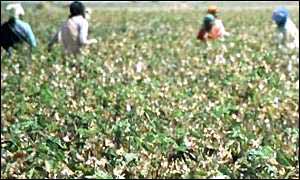 GM cotton has been approved for use in India
India announced on 26 March that it had approved the use of a type of GM cotton for commercial production. The biotechnology industry believes it is poised to persuade consumers that they have nothing to fear.
Last week's decision is important because India has been reluctant to accept the new technology. It is the world's third largest producer of cotton, after China and the US. But it has had to compete with them despite the handicap of low productivity - something it hopes the GM strain will help to resolve. This year, about 71% of the US cotton crop will come from GM plants, up 2% on 2001. In China the area of GM cotton sown rose from 2,000 hectares (5,000 acres) in 1997 to around 700,000 hectares (1,700,000 acres) in 2000. GM crops in the developing world Although cotton is sometimes used for animal feed, it is not something people eat - and anti-GM campaigners say that is a crucial difference which should give the industry pause for thought. Pete Riley, of Friends of the Earth in the UK, told BBC News Online: "It is not a foregone conclusion that developing countries will accept GM varieties as food crops, especially as they may not be as well adapted to local conditions as existing strains. "In any case, there's still huge opposition in India. "Small cotton farmers there have been vociferous in saying no to GM crops - they think it'll mean they're simply handed over to Monsanto and the rest of the industry." Another country which has hesitated over biotechnology is Brazil, but an imminent court ruling there could open the way for the planting of GM soya beans. World hunger One of the proudest boasts of the industry is that it has found a way to tackle world hunger. There is far more to ensuring that malnourished people get fed than simply growing more food.
Nigeria's Environment Minister, Hassan Adamu, says: "To deny desperate, hungry people the means to control their futures by presuming to know what is best for them is not only paternalistic but morally wrong." A book published last year, Seeds of Contention: World Hunger And The Global Controversy Over GM Crops, develops the argument. It was written by Dr Per Pinstrup-Andersen, director general of the International Food Policy Research Institute (Ifpri), and Ebbe Schioler, an agricultural development consultant. They say: "Heated public debate threatens to drown out all serious consideration of the important promise genetic engineering has for the poor and hungry in developing countries." They recognise that the biotechnology industry will need "some sort of ownership protection" if it is to invest in research. But they say this need not be "the form of blanket protection provided by patents... some more limited arrangement such as the plant variety protection regulations might suffice". | | See also:  Internet links: The BBC is not responsible for the content of external internet sites Top South Asia stories now:  Links to more South Asia stories are at the foot of the page. | |||||||||||||
|
Links to more South Asia stories |
 | | ^^ Back to top News Front Page | World | UK | UK Politics | Business | Sci/Tech | Health | Education | Entertainment | Talking Point | In Depth | AudioVideo ---------------------------------------------------------------------------------- To BBC Sport>> | To BBC Weather>> ---------------------------------------------------------------------------------- © MMIII|News Sources|Privacy  |


 E-mail this story to a friend