
|
 |
 | | | | | |||||||||||||||||||||||||||
| | You are in: World: South Asia | |||||||||||||||||||||||||||||
 | | Friday, 15 March, 2002, 18:03 GMT India's secularism under threat? 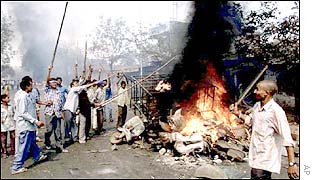 Hundreds of Hindus and Muslims died in recent clashes
Sectarian tensions are calling into the question the essential nature of India as a secular state.
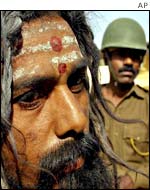
In the town itself, the holy men are in good voice and sing the praises of their god, Ram. "Ram was born here, so Ayodhya is our place, and although India has had British and Muslims to rule it, India is our Hindu nation," says one of the faithful.
This is the toughest of tests for the Hindu nationalist BJP, which relies both on the votes of the hardliners who now call its bluff, and on secular parties to keep it in power. G.M. Banatwala, an MP who also leads the Muslim League, has words of warning - not just for the government, but for its partners too. "Equating national honour and national pride with the dominant religion is the negation of secularism. Those who call themselves secular have become the allies of the BJP. "It is for the secular parties to challenge any rise of communalism for the success of secular democracy in our country." 'Rewriting history' If you give the saddhus (or holy men) Ayodhya, they would have a long list of other disputed sites to try to take next, says Mr Banatwala.
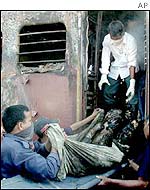
He adds that the BJP's own record of intolerance does not inspire confidence that it will continue to stand firm. "This government comes forward with the idea of rewriting history, having new text books according to its own ideology. "They are creating national hatred through their movement against the madrassas (schools) where religious teachings in Islam are given, and so long as these spectres are there, I am afraid there may be a bloodbath and that secularism in India is threatened." Last-minute plea The worst communal violence here in a decade was unleashed in Gujarat after a trainload of devotees returning from Ayodhya was attacked by Muslims.
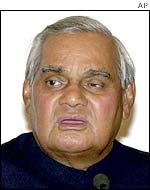
Riot police waded in with batons, but Gujarat state - also run by the BJP - has been accused of making a half-hearted effort to control the mayhem. Prime Minister Atal Behari Vajpayee, who is clearly worried about Ayodhya, made a last-minute plea in parliament for peace, calling for the cooperation of political and non-political bodies alike. Riding two horses But as the head of both the main party for Hindus of all hues and of a secular coalition, Mr Vajpayee is in trouble, says Vinod Nehta, editor of the weekly review Outlook.
"All his public appearances must show that he's speaking for the government. But at the same time, he has to keep the other side happy to show that he has not completely abandoned them. So he's riding two horses at the same. It's a great feat of horsemanship." A seasoned observer, Mr Mehta sums up the prospects for India, the secular nation, and its leadership: "We've seen the secular state almost held to ransom by a motley crowd of men who walk in and out of the corridors of power, who dictate policy. "It's very disconcerting for all of us to see this, but there is a silver lining here, and that is that there is absolute and total revulsion in this country against what happened in Gujarat. "That revulsion is going to have a very negative impact for the BJP as and when elections come, " he said. | |
See also:  Internet links: The BBC is not responsible for the content of external internet sites Top South Asia stories now:  Links to more South Asia stories are at the foot of the page. | |||||||||||||||||||||||||||
|
Links to more South Asia stories |
 | | ^^ Back to top News Front Page | World | UK | UK Politics | Business | Sci/Tech | Health | Education | Entertainment | Talking Point | In Depth | AudioVideo ---------------------------------------------------------------------------------- To BBC Sport>> | To BBC Weather>> ---------------------------------------------------------------------------------- © MMIII|News Sources|Privacy  |




 E-mail this story to a friend