
|
 |
 | | | | | |||||||||||||||||||||
| | You are in: World: South Asia | |||||||||||||||||||||||
 | | Friday, 8 March, 2002, 11:38 GMT Women's Day highlights Afghan plight 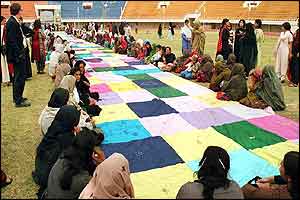 Afghan women can once again study and work The United Nations is marking this year's International Women's Day (IWD) by focusing on the plight of women in Afghanistan. As part of UN and other events organised around the world, America's First Lady Laura Bush will address a conference at the UN in New York.
UN Secretary General Kofi Annan said that after years of conflict, hardship and human rights violations, hope had returned to women and girls in Afghanistan who were again exercising their rights to education, work and an active role in society. Queen Noor of Jordan and Sima Wali, a delegate to the UN peace talks on Afghanistan, are also on the list of speakers at the commemoration at UN headquarters. Other events around the world include:
According to UN figures, only about 3% of girls received some form of primary education during the Taleban's rule. Afghanistan still has the second highest maternal mortality rate in the world. Afghan women have also suffered domestic and other types of violence for the past 25 years, not just under the Taleban, says the UN. Human rights As military action in Afghanistan focused world attention on the Taleban's repression of women, the repression of women in nearby countries such as Saudi Arabia and Pakistan remains largely unscrutinised, said Amnesty International on Friday. "Violence against women is one of the most pervasive yet hidden forms of human rights abuse throughout the world," Amnesty International's Secretary General Irene Khan said.
The UN Children's Fund, Unicef, also said on average, one woman dies in pregnancy or childbirth every minute of the day - about 515,000 women a year - mainly in developing countries. "It is unacceptable that in the year 2002 so many women die in the basic act of giving life," Unicef director Carol Bellamy said. "There has been no significant decline in maternal mortality since the early 1990s, and that is a tragedy," Ms Bellamy said. Amnesty's Irene Khan said the greatest challenge human rights activists faced was "the fleeting, tokenistic interest that governments take in women's human rights". | |
See also:  Internet links: The BBC is not responsible for the content of external internet sites Top South Asia stories now:  Links to more South Asia stories are at the foot of the page. | |||||||||||||||||||||
|
Links to more South Asia stories |
 | | ^^ Back to top News Front Page | World | UK | UK Politics | Business | Sci/Tech | Health | Education | Entertainment | Talking Point | In Depth | AudioVideo ---------------------------------------------------------------------------------- To BBC Sport>> | To BBC Weather>> ---------------------------------------------------------------------------------- © MMIII|News Sources|Privacy  |




 TALKING POINT
 Women's Day
 E-mail this story to a friend