 | An artist's impression of the re-boost manoeuvre 
|
Europe's "Jules Verne" freighter has pushed the International Space Station (ISS) to a higher altitude. The space truck, which docked to the rear of the platform this month, fired its thrusters for a 740-second burn, raising the ISS orbit by 4.5km. The station, now circling at a height of 342km, needs a regular re-boost to keep it from falling back to Earth. The freighter was designed with the manoeuvre in mind and carries extra fuel for the purpose. The re-boost sets the ISS up for the visit of space shuttle Discovery next month. The American orbiter will deliver the main section of the Japanese Kibo science lab. The ISS is travelling at a speed of 7,700m/s and weighs 280 tonnes. In accelerating the station by 2.67 m/s, Jules Verne is able to lift it by 6km. To do this, the computers on board the ISS ignite two of the freighter's four main engines, generating a total thrust of 1,000 newtons. Such re-boost manoeuvres are carried out periodically (about once a month) to push the ISS back into position. The next manoeuvres are scheduled for June, July and August. Jules Verne - its generic name is Automated Transfer Vehicle (ATV) - delivered just under five tonnes of supplies to the platform on its maiden voyage. It is scheduled to stay at the ISS until August, after which it will undock and take station rubbish into a controlled burn-up over the Pacific Ocean. The Jules Verne was filled with 3,490kg of propellant for rendezvous, re-boost and de-orbit manoeuvres. It used about half the load getting to the station and practising docking procedures. | FOLLOW THE PATH OF THE ISS OR ATV |
|  One-Minute World News


 E-mail this to a friend
  Printable version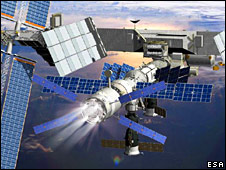
 Enlarge Image
 BBC News


Bookmark with:
What are these?