By Paul Rincon
Science reporter, BBC News, Houston |
  | The southern polar region of the Moon is a possible target 
|
The European Space Agency (Esa) could send a robot rover to the Moon in order to carry out lunar science and test important technologies for the future. Esa is developing the MoonNext concept, which at present is being targeted for a 2015 launch, to present to ministers at a key meeting in November. It will demonstrate the capability to land, survive and carry out robotic operations on the lunar surface. Esa's chief scientist said the mission could land at the Moon's south pole. Dr Bernard Foing told the BBC that Esa was carrying out engineering studies on the mission concept that would be ready to present at the end of the year. Microbial test The MoonNext mission would consist of a 100kg payload lofted into space aboard a Soyuz rocket and then deployed to the lunar surface. The payload would comprise a robotic rover with a stationary geophysical package that would carry an instrument to measure seismic activity and gather geochemical data from the Moon. It would include a life sciences experiment that exposed bacteria to the lunar environment in order to measure the effects of cosmic radiation on the microbes. "[The mission] is a good way to demonstrate that you can land properly. "You will also land in a place that is illuminated so that power and thermal conditions are very good 90% of the time," Dr Foing told BBC News. Constant illumination Temperatures at the Moon's south pole hover around -40C, while the Moon's equator experiences wild extremes of temperature. In addition, the lander would be able to survive at the pole using solar power because scientists have identified two well illuminated ridges here where the Sun hardly ever sets. These lie just a few kilometres from the rim of Shackleton Crater, a 19km-wide, 2km-deep impact depression that has often been proposed as the landing site for a future manned lunar mission. Previous data indicated that water brought by cometary impacts on the Moon might lie permanently frozen on the floor of Shackleton Crater. This has raised the possibility such deposits, if they exist, could be mined by future lunar colonists. Water might be an expensive commodity to transport directly from Earth. Harpoon mechanism Dr Foing said that if MoonNext or another mission were to investigate whether these "ores" do lie frozen in Shackleton, it would have to rely on nuclear power, as the crater lies in shadow. | JAPAN'S MOON MOVIES The Moon is back in fashion. Japan is there currently |
But the Esa scientist speculated that deploying a harpoon to take samples from the crater floor might serve as an alternative. Dr Foing was speaking at the 39th Lunar and Planetary Science Conference in Houston, Texas, where he presented new images of the lunar south pole taken by the Smart-1 spacecraft. Smart-1's Advanced Moon Imaging Experiment (AMIE) has collected many hi-resolution images of the southern polar region. The images, obtained over a full year of changing seasons, were used to study the different levels of solar illumination on the Moon's surface. [email protected]
|  One-Minute World News


 E-mail this to a friend
  Printable version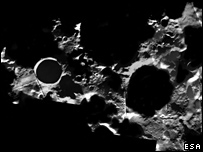
 More details

 BBC News


Bookmark with:
What are these?