By Jonathan Amos
Science reporter, BBC News |
  | Dextre is the third component in Canada's ISS robotics system 
|
"I see this as the great-grandparent of futuristic robots like R2-D2 and C-3PO," enthuses Dan Rey, from the Canadian Space Agency. "This is a very major step forward where now we have a robot that can do human-scale tasks in the harsh conditions of space." Rey is talking about the Special Purpose Dexterous Manipulator; and if that name doesn't really trip off the tongue then simply call this robot Dextre. It sounds almost human. The two-armed machine was a passenger on shuttle Endeavour when the orbiter blasted off from Florida to the International Space Station (ISS) on Tuesday. Unlike R2D2 or C-3PO, it didn't get to sit up front with the astronauts, of course. Dextre rode in the back, in the payload bay, strapped down to a pallet. Its 3.5m-long limbs were detached and set to one side; its "hands", too, had been removed for flight. One of the main mission goals of Endeavour's crew will now be to unload Dextre on to the orbiting platform and re-assemble the robot. "You can think of Dextre as an external handyman," Dr Rey tells BBC News. "Despite its tremendous size, Dextre is the very first space robot able to do delicate motions. "It will take the 'vital organs' of the space station and when they are defective, change them out. So if it's a failed unit, it replaces it with a spare." Electronics boxes, computers, batteries - if they break down, Dextre will be called upon to go and replace them. If an external scientific payload needs moving, Dextre is the robot the station's astronauts will command to do it. SPECIAL PURPOSE DEXTEROUS MANIPULATOR (DEXTRE) Dextre is remotely operated from inside the ISS or from the ground The robot has seven joints in its arms for maximum movement During operations, one arm holds onto the ISS while the other works This maintains stability and ensures the arms do not hit each other Dextre will install and remove small payloads such as batteries |
The 1.5-tonne, aluminium-titanium structure has seven joints making up its shoulder, elbow and wrist. This gives it the freedom of movement to get into any position. On the ends of the arms are Dextre's hands, or Orbital Replacement Unit/Tool Changeout Mechanisms. Each hand consists of parallel retractable jaws, which are used to grip objects. Dextre also has a tool kit and is equipped with lights and video equipment. "Probably the most important thing in Dextre is what we call the force moment sensor," explains Richard Rembala from MacDonald, Dettwiler and Associates, the renowned Canadian robotics company that has led the development of Dextre. "The sensor is located at the wrist on each arm, and this sensor really gives Dextre a sense of touch. As it's grabbing boxes, it can actually measure how hard it's pushing, how hard it's twisting. "This means it can limit the forces applied to structures so it doesn't break them." The ISS has a lot systems that use "plug and play" drawers for ease of maintenance; pull the old one out and push the new one in. These boxes slide on guide rails; and just as with the chest of drawers at home, it can be difficult sometimes to align everything up. So, ISS boxes need to be handled with care or they will jam. Dextre's sensors tell it how to make subtle adjustments to the orientation of boxes so they slide in smoothly.  Canadarm2 picks Dextre up by the head and moves it to its work site
Dextre is the final part in a three-component system that the Canadians have built to service the exterior of the space station. The Canadarm2 was installed on the orbiting platform in 2001. It is essentially a larger, more capable arm than the one currently used in the space shuttle's payload bay. In 2002, it got a Mobile Base System - a trolley that can carry the Canadarm2 along rails running the length of the station. Dextre is the last addition. The two-armed robot will be picked up by its "head" by Canadarm2 and taken to wherever a job needs doing; the whole system running up and down the trolley track. The robot can do its jobs either on the end of Canadarm2, or be put down in a static position. Dextre will be operated remotely by astronauts from inside the space station. The intention is that Dextre takes over some of the duties previously done by humans on spacewalks, also known as extravehicular activity (EVA). "The astronauts will have a choice: do they want to do the task with the robot or do they want to do an EVA?" says Dan Rey. "With Dextre, we're hoping that most of the maintenance work on the outside of the space station will actually be done remotely from the ground, allowing the astronauts to do more science in laboratories like Columbus."  Dextre is prepared at the Kennedy Space Center prior to flight
Robotic servicing is likely to play a key role in the future of space exploration. When the US space agency (Nasa) imposed strict flight rules for its space shuttles following the Columbia accident, it seemed only a robot mission could carry out the vital final servicing mission needed to keep the Hubble Space Telescope functioning. MDA and the Canadian Space Agency investigated whether Dextre technology could be sent up to the telescope to repair its broken systems and install its last experimental camera. And although that will not now happen because Nasa has decided it will allow a shuttle to visit Hubble after all, the concept work is being taken forward. It is likely that robots will soon get to sit up front with the humans. "I believe Dextre is a stepping stone for robotic support of an exploration vehicle that will be going to Mars, that will need servicing during the six-month journey to get to the Red Planet," Dr Rey told BBC News. "Although Dextre works in a zero-g environment, the lessons we learn with it we will apply on the Moon or on Mars, for co-operative robotics with astronauts." [email protected]
|  One-Minute World News


 E-mail this to a friend
  Printable version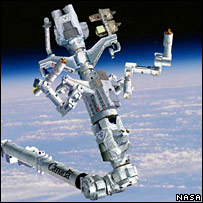
 Enlarge Image
 The lessons we learn with it we will apply on the Moon or on Mars, for co-operative robotics with astronauts

 'External handyman'
 BBC News


Bookmark with:
What are these?