 | The mission's main goal is to install and commission Columbus 
|
US and European astronauts have completed their second spacewalk of the current space shuttle mission. Hans Schlegel took part in this outing after being replaced on the first spacewalk when he fell ill.
He joined American Rex Walheim on the activity, during which they installed a new nitrogen tank on the International Space Station (ISS).
Europe's space lab, Columbus, was unloaded from the shuttle Atlantis and docked with the ISS on Monday.
After 1427 GMT (0927 EST) Mr Schlegel floated outside the linked space shuttle Atlantis and ISS with Mr Walheim two days after missing out on the flight's first spacewalk.
He had earlier refused to say what had been ailing him: "Medical issues are private," he said.
| Hans Schlegel was too ill to take part in the first spacewalk |
Space agency officials stressed there would be no changes to Wednesday's six-hour, 45 minute-long spacewalk as a result of Mr Schlegel's illness, and that he would do everything just as he had practised before last week's launch. No one was opposed to him going outside to perform the strenuous spacewalking work, officials said.
Mr Schlegel said he backed Nasa's decision to pull him from the first spacewalk because of his illness and delay Columbus' installation by a day.
Monday's spacewalk to help install the orbiting laboratory lasted nearly eight hours - longer than expected.
Mr Schlegel was replaced by shuttle crew member Stan Love, who ventured into space with fellow American Rex Walheim.
The pair assisted as the 12.8-tonne Columbus module was plucked from its berth in the Atlantis shuttle's payload bay by a robotic arm. The module was then attached to the Harmony connecting Node 2.
Routine inspection
Columbus cost about $2bn (�1bn) and has room for three researchers in fields ranging from crop breeding to the development of advanced alloys.
| COLUMBUS FACTS Total length - 6.8m Diameter - 4.5m Volume - 75 cu m Launch mass - 12.8t Operation - 3 crew Cabin temp - 16-27C Total power - 20kW |
The lab is the first part of the ISS that Esa will control. Before docking with the space station on Saturday, astronauts aboard Atlantis guided the shuttle in a back-flip manoeuvre that allowed crew on the space station to photograph the shuttle's protective heat-resistant tiles.
The images were assessed by engineers on Earth for any possible damage that may have been caused to orbiter tiles during lift-off.
This became a routine safety measure after the shuttle Columbia disintegrated on re-entering the Earth's atmosphere in 2003.
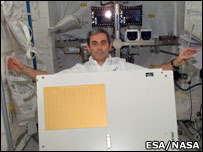
Esa astronaut Leopold Eyharts will be staying on the station to commission Columbus, a process that should take a few weeks to complete.
| Leo Eyharts will be staying on the space station
|
Its installation will mean Esa becomes a full member of the orbital project. Atlantis was launched from the Kennedy Space Center in Florida on Thursday, and is due to return to Earth now on 19 February, a day's extension to the originally planned 11-day mission.
An intensive programme of research in weightless surroundings is planned once Columbus is up and running.
The experiments will also help researchers better understand the physiological demands of long-duration spaceflight, something that will be important if humans are ever to colonise the Moon or travel to Mars.


 One-Minute World News
  News services


 E-mail this to a friend
  Printable version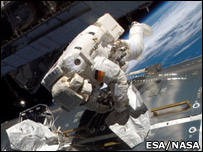
 Enlarge Image




Bookmark with:
What are these?