 | On 3 October: Cool colours trace the thinning 
|
Europe's new Metop satellite has revealed the extent of ozone thinning over Antarctica this year. At its worst in late September, the hole was twice as big as Europe.
Nearly 200 governments recently agreed a faster timetable for phasing out the chemicals thought to be depleting the protective layer in the stratosphere.
This has been the first opportunity for Metop, Europe's most sophisticated weather and climate observer, to study the hole since its launch last year.
Scientists at the German Aerospace Center (DLR) analysed data from the Global Ozone Monitoring Experiment 2 (GOME-2) instrument on the satellite.
They say some unusual meteorological conditions this year drove extensive thinning over the South Atlantic and South America and a build-up of ozone over Australia.
However, the thinning this year has been well short of last year's record hole, which at times was bigger than North America.
Metop is one of three identical spacecraft that will be flown by Europe in a polar orbit over the coming decades to gather continuous data.
It is a joint project between the European Space Agency (Esa) and Eumetsat, the intergovernmental organisation charged by European member states with operating a series of orbiting weather observatories.
Other satellites also monitor ozone, including Europe's main Earth-observation platform, Envisat.


 One-Minute World News
  News services


 E-mail this to a friend
  Printable version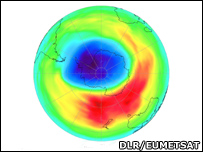
 Enlarge Image


Bookmark with:
What are these?