By Paul Rincon
Science reporter, BBC News, Houston |

 | The tiger stripes mark the southern polar region of Enceladus (Nasa/JPL/SSI) 
|
The plumes of water that erupt from Saturn's icy satellite Enceladus can be traced back to a radioactive "meltdown" shortly after the moon formed. The discovery, in 2005, of water vapour spewing from geysers at Enceladus' south pole took scientists by surprise.
How this tiny, ice-covered moon generated the amounts of heat needed to fuel these eruptions was a puzzle.
Now scientists say a short-lived burst of radioactivity early in its history kicked off a slow cooking of its core.
The new model for Enceladus' evolution was presented at the Lunar and Planetary Sciences Conference here in Houston, Texas.
Pocket dynamo
When the Voyager 2 probe visited Saturn in the 1980s, it found that Enceladus was unlike many of the other moons in its neighbourhood, whose pockmarked surfaces bore testament to billions of years of heavy bombardment.
By contrast, Enceladus had a relatively smooth, young surface that must have been renewed by some recently active process.
 Cassini has seen plumes of material head into space |
In 2005, Nasa's Cassini orbiter discovered an active region near the moon's south pole marked by tiger stripe-like features. Geysers were seen at this location to hurl water vapour and ice crystals into space. Since then, the challenge for researchers has been to figure out how this diminutive ball of ice and rock produced the heat necessary to power these eruptions.
The answer, say Dennis Matson and Julie Castillo-Rogez of Nasa's Jet Propulsion Laboratory in California, probably lies in a brief period of radioactive heating when the moon was a youngster.
The model supports the recent finding that Enceladus' plumes contain molecules that require searing temperatures in order to form.
Dr Castillo-Rogez said the "only way" to achieve such high temperatures was "through the rapid decay of some radioactive species".
Dr Matson said that temperatures in Enceladus' interior could have reached as high as 1,000 Kelvin (727C).
"I don't know if it is that hot today, but it certainly got up that high," he said.
Rapid decay
Enceladus started off 4.5 billion years ago as a jumbled-up ball of ice and rock containing the rapidly decaying radioactive isotopes aluminium-26 and iron-60.
The moon probably acquired these radioactive species from minerals called calcium-aluminium-rich inclusions (CAIs), which formed early in Solar System history and are found today in meteorites.
According to the new model, the decay of these isotopes over a period of about seven million years would have generated enormous amounts of heat.
This heat melted the moon's ice, causing the rocky material to sink to the moon's centre, where it consolidated to form a core.
Once this intense, but short-lived period of heating was over, other effects may have taken over the warming of the moon's interior.
More slowly decaying radioactivity in the core along with the tidal forces exerted on Enceladus by Saturn's gravity may be responsible for the heating which continues today.
Gas detection
The researchers say their model neatly explains the detection of gaseous nitrogen in the plume expelled from geysers.
Nitrogen is not thought to have been part of Enceladus' original make-up. Instead, Dr Matson and Dr Castillo-Rogez believe it is formed via the breakdown of ammonia, where the warm core and the surrounding liquid water meet.
However, the decomposition of ammonia to form gaseous nitrogen requires temperatures of about 577C (1,070F).
Slowly decaying radioactivity and tidal forces cannot account for such high temperatures alone, but they can when combined with the "hot start" model.
Since the discovery of Enceladus' plume by Cassini, the moon has become a high priority target for future exploration.
With a brew of organic chemicals in the interior, a heat source and liquid water, the moon has all the key ingredients needed for life.

Today's activity is driven in part by tidal heating
[email protected]


 One-Minute World News
  News services
 E-mail this to a friend
  Printable version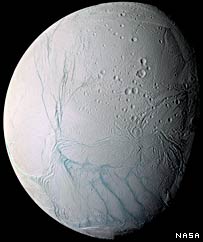
 More details


