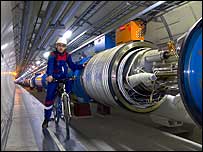
The Large Hadron Collider (LHC) particle accelerator at Cern will now be powered up in May 2008 after a number of delays in its construction. A planned low-energy run, originally scheduled for later this year, had been dropped as a result of the setbacks, project scientists said.
The giant underground laboratory on the French-Swiss border is designed to probe the limits of physics.
The facility will collide sub-atomic particles in a 27km-long ringed tunnel.
Under pressure
In March, one of the eight "inner triplet" magnet assemblies failed a pressure test.
"The low-energy run at the end of this year was extremely tight due to a number of small delays, but the inner triplet problem now makes it impossible," explained Lyn Evans, the LHC project leader at the European Organisation for Nuclear Research (Cern).
 | The Large Hadron Collider takes shape 
|
The inner triplets are located on either side of the four major detector experiments located around the giant ring.
The magnets need to be cooled to 1.9 Kelvin (-271C) using superfluid helium inside a vacuum vessel in order to focus particle beams prior to collision at the four experiment points along the accelerator.
When it is switched on, the LHC will collide two beams of particles head-on at super-fast speeds, recreating the conditions in the Universe moments after the Big Bang.
"We'll be starting up for physics in May 2008, as always foreseen, and will commission the machine to full energy in one go," Mr Evans added.
"There is no big red button when you're starting up an accelerator, but we aim to be seeing high-energy collisions by the summer [of 2008]."


 One-Minute World News
  News services


 E-mail this to a friend
  Printable version

 In pictures


