 Hinode's orbit gives it a near-continuous view of the Sun |
The new Japanese spacecraft sent into orbit in September to study the Sun has returned its first scientific data. The probe lifted off as Solar-B but is now called Hinode, or "sunrise" in Japanese. The renaming of recently launched craft is a Japanese custom.
The platform has three telescopes to study solar flares, colossal explosions that occur in the Sun's atmosphere.
The mission team, which includes UK and US scientists, reports Hinode's systems to be in excellent health.
"Waiting for the first data from an instrument that has taken years to design and build is always a heart-stopping moment," said Professor Len Culhane, the principal investigator on the extreme ultraviolet imaging spectrometer (EIS).
The experiment was developed in Britain by University College London's Mullard Space Science Laboratory.
"We create incredibly sensitive detectors such as EIS, then strap them to a rocket and hurl them into space under extremely challenging conditions. Finding out that it survived and is working correctly is a huge relief because the options are very limited if it is not."
Solar flares release energy equivalent to tens of millions of hydrogen bombs in just a few minutes.
Dramatic events
Hinode will attempt to find out more about the magnetic fields thought to power these dramatic events and try to identify the trigger that sets them off.
The ultimate goal for scientists is to use the new insights to make better forecasts of the Sun's behaviour.
 | Solar-B's orbit gives it a near-continuous view of the Sun 
|
Flares can hurl radiation and super-fast particles in the direction of the Earth, disrupting radio signals, frying satellite electronics, and damaging the health of astronauts.
Hinode is part of a fleet of spacecraft now dedicated to understanding the relationship between the Sun and the Earth.
Its launch was followed last month by that of Stereo, a US space agency (Nasa) mission that will make 3D observations of our star. Its focus will be coronal mass ejections, a related phenomenon to solar flares that also influence the "space weather" around the Earth.
Hinode was launched from the Japan Aerospace Exploration Agency (Jaxa) Uchinoura Space Centre at Uchinoura Kagoshima in southern Japan on 22 September.
As well as the EIS, the spacecraft carries a Solar Optical Telescope (SOT), and an X-Ray Telescope (XRT).
They will make continuous, simultaneous observations of specific solar features, to observe how changes in the magnetic field at the Sun's surface can spread through the layers of the solar atmosphere to produce, ultimately, a flare.


 One-Minute World News
  News services


 E-mail this to a friend
  Printable version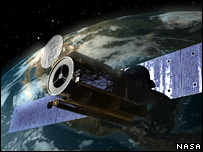
 Enlarge Image


