By Jonathan Amos
Science reporter, BBC News |

 | The final design of the SKA has yet to be settled 
|
Australia or South Africa will get to host one of the great scientific projects of the 21st Century. The countries have been shortlisted to be the home of the 1bn-euro-plus Square Kilometre Array (SKA), a giant next-generation radio telescope.
The SKA's huge fields of antennas will sweep the sky for answers to the major outstanding questions in astronomy.
They will probe the early Universe, test Einstein's theory of gravity and even search for alien intelligent life.
The steering committee tasked with pushing the project forward has now settled on the two prime locations where the exacting technical demands of the telescope could be met.
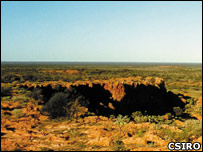
For Australia, this would be a site at Mileura station, about 100 km west of Meekathara in Western Australia. For South Africa, the central location would be at Karoo in the Northern Cape, about 95km from Carnarvon. But the sheer scale of the SKA - it will have thousands of antennas spread over 3,000km - means the facility will spill over into neighbouring countries.
Political dimensions
A key technical requirement of the core site is that there must be very low levels of man-made radio signals, because interference will mask the faint cosmic radio waves the telescope is designed to detect.
This means the eventual winner of the SKA will have to restrict local mobile phone and TV transmissions, which now blight many other radio astronomy facilities around the world.
| See the African site
|
"This is critical, and in fact both the South African and Australian governments have already made excellent progress towards this," said Professor Phil Diamond, from the International SKA Steering Committee. "A final decision will depend on many factors, such as whether the individual governments involved will be able to contribute significant funds to the infrastructure - the power, the roads, the data communications, and the like; and there will no doubt be some political discussions that go on above the scientists," he told BBC News.
Like all the grand scientific projects of the 21st Century (the space station, the Iter fusion reactor, the International Linear Collider, for example), the immense size of the SKA means no one country can afford - or has the expertise - to carry it through alone.
The project aims to produce a radio telescope with a collecting area of one million square metres (one square km)) - equivalent to about 200 football pitches.
Cosmic times
The final technology incorporated into the design and its configuration have yet to be settled; but it is likely that about 50% of the collecting area will be located in one place - the host country. Outrigger facilities, which will be many hundreds, even thousands, of km away will then send their data to be combined with those of the central station.
This practice known as interferometry is widely used by astronomers today.
The SKA will investigate light sources in the sky that radiate at centimetre to metre wavelengths - but it will achieve sensitivities that are far beyond the reach of current telescopes.
| Pulsars are a key target |
This should allow it to see the hydrogen in the first stars and galaxies to form after the Big Bang. The SKA will pinpoint precisely the positions of the nearest one-hundred-million galaxies. Scientists hope their structure will reveal new details about "Dark Energy", the mysterious negative pressure that appears to be pushing the cosmos apart at an ever increasing speed.
ET TV
The telescope will also map out the influence of magnetic fields on the development of stars and galaxies. And it will zoom in on pulsars, the dead stars that emit beams of radio waves which sweep across the Earth like super-accurate time signals.
Astronomers believe these objects may hold the key to a more complete theory of gravity than that proposed by Einstein.
| See the Australian site
|
"The 'holy grail' in this game would be to find pulsars going around a black hole. When we find that, we can do tests on gravity that go way beyond what is possible at the moment - and many people believe Einstein's theory will fail those tests," commented Professor Steve Rawlings, from the Department of Astrophysics at Oxford University, UK. The SKA should also nail the question about the existence of extraterrestrial intelligence in our cosmic neighbourhood.
"Our television systems and our airport radars transmit at the sorts of frequencies that the SKA will be sensitive to. If there are other technological civilisations out there within a few hundred light-years, we would detect the leakage radiation from their planets," said Professor Diamond.
The first elements of the SKA should come online in 2014, with the full network of antennas in operation by 2020. The estimated cost currently is in the region of 1.3bn euros (�0.9bn; $1.6bn)


 One-Minute World News
  News services


 E-mail this to a friend
  Printable version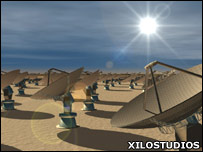
 More details
 We can do tests on gravity that go way beyond what is possible at the moment