By Mark Kinver
Science and nature reporter, BBC News |

He has arrived at a fish restaurant in West Byfleet, Surrey, to carry out an energy survey on behalf of the Carbon Trust.
"Any increase in energy costs has an immediate impact on a business's profitability," says Mr Tibble.
"It is a very big concern, but any organisation that is able to cut their demand for energy can put the savings straight on to their bottom line."
The businessman who is hoping to benefit from reduced bills is Michael Rhodes, managing director of Rhodes Food Ltd.
He owns seven restaurants across the county, and has seen his energy costs more than double in recent years. This year's gas and electricity bills total �58,700.
Under a scheme operated by the Carbon Trust, a government-funded organisation, British firms that spend more than �50,000 a year on energy are eligible for a free energy survey.
 | How a survey identifies ways to save energy and cut costs 
|
With his gas bill set to increase by a further �10,000 over the next 12 months, Mr Rhodes is very keen to cut costs. "Energy has become one of the expenses we really have to keep an eye on," he says.
"I have taken energy-saving measures as far as I felt I could on my own, and I wanted to capitalise on the specialist knowledge available."
Before arriving at the largest Superfish restaurant in Mr Rhodes' chain, Mr Tibble studied a range of documents to build an energy profile, including a number of monthly meter readings.
"Looking at the data," explains Mr Tibble, "gives you so much information and so many clues as to where you can make savings.
"So, the important thing is to make sure you get regular, accurate readings. The only way to guarantee this is to read the meter yourself."
Otherwise, he says, any signs of a reduction in energy use could be lost: "It is not unusual for energy providers to issue invoices based on estimates covering a period of six months or more, and you cannot use that data to make any worthwhile conclusions."
Energy profile
The survey begins in the basement, the location of the boiler that provides all the heat and hot water for the restaurant and kitchen.
| SMART METERS |
"The thing that hits me in the face down here is the heat, " says Mr Tibble. He measures the air temperature with his hi-tech thermometer; it reads 30C (86F). Mr Rhodes jokes that he had thought about converting the space into a sauna, but says it would be good to stop wasting so much heat.
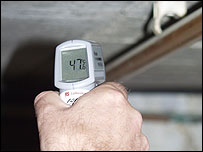
It doesn't take Mr Tibble very long to find the source: "A lot of the heat down here is not just from the boiler, I would say 60-70% of the heat is from this," he says, pointing at unclad pipes carrying hot water from the boiler.
The thermometer shows a reading of 47C (116F). "One of the recommendations will be to insulate these pipes," he tells Mr Rhodes.
The next stop is the dining area on the ground floor. Mr Rhodes explains that the air conditioning unit has been working overtime.
"The big problem we have is that the kitchen's extractor fans pull cold air from here, while the front door lets the heat in."
Mr Tibble says it is good to see the dining area segregated from the kitchen and the takeaway service counter to limit draughts and changes in temperature.
"Quite often you can go into an establishment and find that the heating is set to 22-23C (71-73F), yet the windows are open.
"In other cases, you can go into an office where the thermostat for the heating may be 22-23C, but the air conditioning unit is set to 20C (68F).
"So the air conditioning is trying to cool the room, while the heating is trying to heat it up," Mr Tibble observes. "All it takes is one minute of your time to set the controls properly."
'On the ball'
|  The fish and chip industry is 100 years old, so trying to be at the forefront and move things forward is often a challenge The fish and chip industry is 100 years old, so trying to be at the forefront and move things forward is often a challenge |
The next area to come under the scrutiny of the survey is the kitchen. In 2004, Mr Rhodes received an interest-free loan from the Carbon Trust to buy more efficient fryers.
"The [previous] fryers had been operating since the 1980s and were not as efficient as they could be," he recalls.
"The fish and chip industry is 100 years old, so trying to be at the forefront and move things forward is often a challenge."
The new fryers, however, are helping cut his energy costs. Mr Rhodes says they are 40% more efficient than the old ranges, and the savings made should pay for the equipment in five years.
Another piece of technology that Mr Rhodes is interested in is solar power. He plans to replace the building's roof in the near future, and the two projects could be combined.
However, he says it is proving a challenge: "Domestic solar costs about �2,500, but it is very difficult to find any information for commercial installations.
As the pair sit down to discuss the findings from the survey, Mr Tibble says Mr Rhodes is "on the ball" when it comes to saving energy.
"Michael employs a 'we can do this' approach across all his businesses, and that is probably why he is successful."
Mr Rhodes is much more pragmatic: "It is like everything else, I try to go through the ins and outs of the issue because, ultimately, we want to cap our costs."


 One-Minute World News
  News services
 E-mail this to a friend
  Printable version
 In pictures


