 Beagle 2: It probably never got this far |
BBC News Online's science editor Dr David Whitehouse asks what lessons have been learnt from the loss of the UK-led Beagle 2 Mars lander. There has never been a space mission like Beagle 2 and, if Monday's report into its loss is acted upon, there will never be one like it in the future.
That is not to say European space scientists will not again build a probe to land on Mars. The scientific pull of the Red Planet is too great.
Beagle almost got there and should be applauded for that, but the report into its loss shows that the reality of the project did not match its public persona.
Officials at the European Space Agency (Esa) have said that, in retrospect, it was too great a risk to take. Esa's head of science, David Southwood, has said he always felt it was going to be a close-run thing.
All space missions are risky and every space scientist must be prepared for a total loss. That is why every effort is put into minimising those risks.
It is clear that there were aspects of the Beagle project that did not help reduce the already long odds of success.
It is a fact of life with risks that if they come off you are a hero and all will be forgiven; but if you fail, you will be criticised, directly or indirectly.
Peculiar mission
Beagle was peculiar for several reasons but it was not unusual in that it was rushed or that it did not have enough money.
David Southwood said that, at almost �50m, Beagle had enough money - the problem was that cash was not available at the start of the project.
What happened to Beagle 2 as it headed to Mars? 
|
The reasons for Beagle's loss lie elsewhere than money. The report, and its 19 recommendations, paint a picture of an unusual and not entirely healthy project that added to its chances of failure. The Beagle engineers involved achieved great things working in what Professor Southwood repeatedly called constrained circumstances, but he also said that if you took the best people in the world and put them in the wrong conditions then they could not win.
This is especially true when you are building a novel probe to land on Mars. Remember, two-thirds of all Mars missions have failed - and that includes some very well funded US spacecraft.
Aspects of the engineering on Beagle were outstanding, especially the miniature Gas Analysis Package and the arm. These may find a place in future missions.
A new Beagle mission is problematical, though. There are no European missions planned to Mars and sending a Beagle-like mission on its own is too costly without cancelling another project, and that would arouse much scientific opposition.
Unlucky in space
Beagle was conceived and led by Professor Colin Pillinger, of the UK's Open University. The inquiry report does not name names but at the press conference to make it public, almost every time it was said that no one was being blamed the next comment that was made concerned poor management.
Professor Pillinger has an acknowledged idiosyncratic style and it is a testament to his drive and unstoppable enthusiasm that Beagle got built. But perhaps his passion and desire for control worked against him.
 | BEAGLE 2: THE LESSONS |
One of the conclusions of the report is that there should be clear commitments, responsibilities and lines of accountability. Such a complex space mission, involving large amounts of money, could not be done on a goodwill basis, Professor Southwood said. This was perhaps a veiled reference to the "gentlemen's agreements" (rather than clearly defined contracts) that were common in Beagle's early days.
During its design and construction, Professor Pillinger was seldom out of the media spotlight as he tried to raise the mission's profile and attract sponsors.
It was this aspect of the mission that made Beagle unique and it has drawn criticism. Professor Southwood said there was no way any future space mission involving Esa would be supported in this way again.
It was counterproductive, he argued. It diverted a space scientist into an area in which he was not a professional and away from an aspect of the mission that was ultimately unsuccessful.
Because of factors - some of which could be avoided, some of which could not - Beagle went into space with the odds stacked against it.
Space probes should be built that are unlucky if they fail, not, as in Beagle's case, are very lucky if they succeed.
So there we have Beagle. A bold idea that did not come off, built in a way that will not be repeated.


 One-Minute World News
  News services
 E-mail this to a friend
  Printable version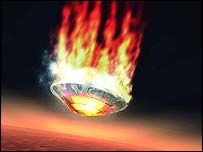
 In pictures


