Spirit and Opportunity: Nasa space robots' Mars exploration mission 
|
Europe's Mars Express probe will help Nasa spot minerals formed in water that may be present at the landing site where the US Spirit rover touched down. The two teams will share their data to better understand the area's geology, the first time this has happened.
Mars Express will provide Nasa with information from its powerful camera and two spectrometers that will analyse the composition of surface rocks.
Spirit is turning around and rolls on to the Mars surface on Thursday GMT.
Mission scientist Albert Haldemann said the collaboration between the US space agency's (Nasa) Spirit and Mars Express would be a "historic" opportunity and a "co-ordinated observation that is international in nature".
The European Space Agency (Esa) orbiter will overfly Spirit's Gusev Crater landing site on Friday at an altitude of about 300 kilometres.
Mars Express is in an elliptical orbit around Mars and its lowest approach to the Martian surface - or periapsis - will be right over Spirit's landing site.
Nasa scientists said they had known about this approach by Mars Express for three weeks. It comes at a convenient time for the rover, which is just beginning its exploration of the Martian surface.
Scientists from both teams will work to evaluate the data. But, Mr Haldemann said: "This is not something, necessarily, where you pull out a result from the data right away."
Precise imaging
Mars Express will fly over Spirit's landing site on Friday, after the rover has performed its "egress" or departure from the landing pad.
The European probe's high resolution stereo camera will produce four colour images of the landing site up to a resolution of 10 metres to one pixel.
"We're not going to be able to see the rover, but we're going to get some context for the site," said mission scientist Ray Arvidson. In addition, the French imaging spectrometer Omega will provide Nasa with information on the composition of rocks in the Gusev Crater.
"The wavelength region that's covered [by the spectrometer] is very rich in terms of inferring minerals present on the surface, particularly minerals that may have been formed in the presence of water," said Dr Arvidson.
Another spectrometer on board Mars Express will provide similar data.
On Friday, Spirit will also begin pointing its panoramic camera at the sky in order to analyse concentrations of dust in the Martian atmosphere.
Mission engineer Kevin Burke said that Spirit had now performed a 95-degree turn to the right on the landing pad, a hazardous move which saw the rover drop a wheel on to the ramp as it rotated.
 |  The wavelength region that's covered [by the spectrometer] is very rich in terms of inferring minerals present on the surface, particularly minerals that may have been formed in the presence of water The wavelength region that's covered [by the spectrometer] is very rich in terms of inferring minerals present on the surface, particularly minerals that may have been formed in the presence of water  |
The rover now needs to perform a further 20-degree turn to the right, after which it will have completed its 120-degree rotation and will be able to leave the landing pad. The command for the rover to "egress" or depart from its pad will be sent by ground controllers on Thursday at 0730 GMT.
Mission scientists will know whether this has been successful by around 0845 GMT.
Prior to the co-ordinated observation between Esa and Nasa, Mars Express had been positioning itself in orbit around the Red Planet and trying to talk to its "baby", the British-built lander Beagle 2.
But nothing has been heard from beagle since it was due to land on Christmas Day. Spirit will also communicate with the US orbiter Mars Odyssey on Thursday.


 One-Minute World News
  News services

 E-mail this to a friend
  Printable version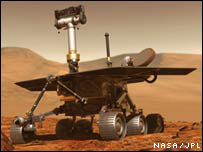
 At-a-glance


