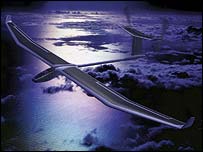
One of the great challenges will be flying at night 
|
Record-breaking aviators Brian Jones and Bertrand Piccard hope to harness the Sun's power to fly round the world. The pair gained worldwide recognition in 1999 when they became the first to circumnavigate the globe in a balloon.
Now they plan to repeat the journey in a solar-powered aeroplane which will have to use batteries to fly at night.
A feasibility study has confirmed the viability of the Solar Impulse project and experts are now preparing to design the craft for launch some time in 2006.
Immersive pilots
Shaped like a glider, the plane will be black and covered in blue photovoltaic cells.
Sixty-metre wings and two tail-mounted engines will enable it to take off unassisted and carry the heavy batteries needed to store energy for night flying.
 Helios broke up over the Pacific, 16 km west of the Hawaiian island of Kauai |
Jones and Piccard are consulting the world's best glider and yacht manufacturers to help them source state-of-the-art composite materials. Meanwhile robotics experts at the Swiss Federal Institute of Technology, Lausanne, are assessing the idea of making the craft interactive with the pilot.
"The design incorporates a computerised body vest," explains Jones. "If there's stress on part of the wing, the pilot would feel pressure on one side of his body.
"Equally, if the pilot is stressed the plane would sense this and only feed him must-know information."
Press for play
As well as pushing the limits of technology, the pair hope the aeroplane will prove the viability of sustainable development.
 Prototype flights from 2006; ultra-long-distance flights from 2009 |
It will not carry any fossil fuels on board and so will offer completely pollution-free transport. "The great thing about this project is that it allows us to be a force for good from the beginning," says Jones.
"We want to use it as a communications platform for the concept of sustainable development and renewable energy resources.
"Solving our ecological problems is not simply a case of persuading people to turn off the lights and not keep their VCRs on standby. This may be important but it won't solve the situation. What will solve the situation is technology."
Solar acquaintance
Jones and Piccard's first aim is to fly the plane at night, something never before achieved in a solar-powered craft.
After that, they hope to recreate historic journeys made in conventional aircraft by the likes of Lindberg and Amy Johnson. The ultimate goal will be to fly non-stop round the world.
 Breitling Orbiter 3: Jones and Piccard have the pedigree |
The task that confronts them is a huge one. The US space agency's Helios project - an advanced solar-powered craft - had been attempting to overcome the hurdle of night flying on batteries when it broke up in a test flight over the Pacific this year. Jones, though, is well aware of the technological hurdles he faces. He was mission controller on the ill-fated QinetiQ 1 balloon attempt to take a manned envelope 40 kilometres above the Earth's surface.
The balloon, which ripped on inflation, was to have flown a tethered solar aeroplane, called Zephyr 3, under the gondola.


 One-Minute World News
  News services

 E-mail this to a friend
  Printable version
 Enlarge Image