By Dr David Whitehouse
BBC News Online science editor |

From the side our galaxy might look like this 
|
A new large-format camera has obtained a spectacular "edge-on" image of a star system considered to be a galaxy very much like our own Milky Way. The 16 Megapixel infrared camera was built by the University of Hawaii, US.
Its size allows larger views of the sky than is possible using current sky cameras attached to telescopes.
The technology is being developed for the James Webb Space Telescope which will replace the Hubble Space Telescope in about 10 years' time.
Sensitive silicon
Astronomers have released the first image from the new 16 Megapixel infrared camera recently mounted on the University of Hawaii 2.2 metre (88 inch) Telescope on Mauna Kea.
The new camera provides a sixteen-fold increase in sky coverage together with much higher sensitivity than the current cameras in widespread use on telescopes.
The development of this new technology has been driven by the requirements of the US space agency's forthcoming James Webb Space Telescope (JWST), the next step beyond the Hubble Space Telescope.
The JWST, which will have six times the light-collecting area of Hubble, will be launched into an orbit far beyond the Moon allowing extremely sensitive infrared observations.
The new detector is based on state of the art silicon chips which, at a size of nearly five square centimetres are some of the largest ever produced. The chips are mounted so that four of them comprise a 16 Megapixel camera.
Jigsaw puzzle
The imaged galaxy, NGC 891, is in the constellation Andromeda at a distance of about 10 million light-years. It is of particular scientific interest because it is very similar to our own Milky Way galaxy but is seen almost exactly edge on.
Richard Wainscoat of the University of Hawaii emphasises the importance of being able to image the entire galaxy in a single exposure with the new camera.
"With smaller cameras, galaxies such as NGC 891 had to be imaged in small postage stamp sized pieces that had to be painstakingly pieced together - the new camera produces a better image in a tiny fraction of the time," he says.
"By allowing us to image very large areas of the sky, this camera will allow us to detect some of the most distant galaxies in the Universe."


 One-Minute World News
  News services

 E-mail this to a friend
  Printable version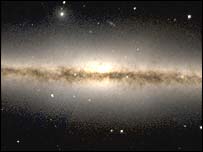
 Enlarge Image