By Helen Briggs
BBC News Online science reporter |

 It has returned a wealth of data |
The giant volcanoes of Io and the hidden oceans of Europa were complete mysteries until the Galileo space craft arrived at Jupiter. It flew close to the icy moons of the planet, discovered by the astronomer Galileo Galilei in 1610.
The probe has travelled almost three billion miles since its launch but now, after 14 years of exploration, it is about to make its final encounter with the largest planet in the Solar System.
Early times
It will burn up in a trail of fire as it enters the dense atmosphere around the planet.
The mission is regarded as a landmark in space history and scientists are sorry to see it go.
 | JUPITER FACTS The fifth planet from the Sun Largest Solar System world Would contain 1,300 Earths Gas giant with small rock core |
"It's sad to see it end but if it didn't die with a bang, it would have died with a whimper," says Fred Taylor, professor of physics at Oxford University, who has worked on the project for 30 years. Galileo has given the first real insight into Jupiter as a planet, he says, with its omnipresent storms and a complex cloud system.
The data has also shed light on the composition of the gas giant and how the early Solar System was formed.
Saturn next
Scientists are still sifting through the treasure trove of new information about the fifth planet from the Sun and will do for years to come.
"It's had a good run - it's left us with an atlas of all the minor satellites of Jupiter," says Tony McDonnell, professor of planetary sciences at the UK's Open University, Milton Keynes.
The Galileo probe's last journey 
|
Galileo was one of Nasa's Rolls Royces", he says, a fleet of big, expensive space craft developed at the Jet Propulsion Laboratory in Pasadena, California. The last of this generation is the Cassini space craft, a "sister" to Galileo.
Cassini, which carries the European Space Agency's Huygens probe, is visiting Jupiter's neighbour, the ringed giant Saturn and its moon Titan.
In July next year Cassini will begin a four-year tour of Saturn and its moons, opening a new chapter in the study of the outer planets.


 One-Minute World News
  News services
 E-mail this to a friend
  Printable version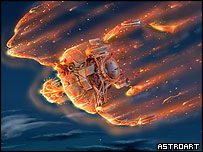
 At-a-glance

