With one announcement from the government, wind power has been transformed from a minor niche in the UK energy market into a major player. The scale of the development is staggering.
Put together, all of the land-based turbines currently harvesting wind energy in Britain add up to around 500 megawatts - about 0.5% of the electricity needs of the country.
 | WIND ENERGY IN THE UK Currently supplies around 500 megawatts New announcement will take that to 5,000 MW Currently supplies about 0.5% of UK energy needs Government has a target of 10% of energy needs from renewables by 2010 And 'aspires to' 20% by 2020 |
If Monday's options for offshore turbines are all taken up, it will increase that figure more than tenfold: up to six gigawatts (6,000 megawatts) - enough to supply all the homes of Greater London with some to spare. This will go a considerable way towards meeting the government's target of producing 10% of our electricity from renewable sources by 2010.
But it is still not the whole way by any means, and 10% remains a tough target.
Dividing up swathes of seabed on a map is one thing but getting the turbines constructed and working is quite another.
The first, much smaller round of offshore wind farms was announced three years ago.
Guide to off shore wind power in the UK and Europe 
|
But progress towards building them has been disappointingly slow. Only two out of the 17 proposed projects are under construction, and none are yet generating electricity.
So it is likely to be some years before the areas earmarked on Monday begin to supply power.
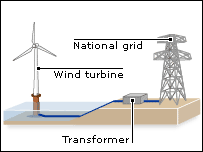
Major technological challenges lie ahead, not least the construction of a network of cables to carry electricity from several miles offshore to the National Grid.
Investment issues
And building the turbines for the latest round will require private investment of some �6bn.
While plenty of companies have expressed interest, they will want further guarantees from ministers before parting with that sort of money.
In particular, they want a commitment that the amount of renewable energy which electricity supply companies are required to buy, will continue to increase beyond 2010.
In its Energy White Paper published earlier this year, the government declared an "aspiration" to produce 20% of power from renewables by 2020.
But a review of the current obligation on supply companies is still two years away.
|  This does provide the UK with the opportunity to become a world leader in wind-power technology This does provide the UK with the opportunity to become a world leader in wind-power technology  |
And the outcome of that review will determine just how much investment is likely to be available for today's hugely ambitious project. Even with all these caveats, the response from most of the main environmental groups has been nothing short of gushing.
Organisations such as Greenpeace, accustomed to slamming the government's environmental record, were talking about the dawn of a new era.
Most but not all. The Royal Society for the Protection of Birds welcomes the principle of offshore wind, but still has deep concerns about the impact of large-scale developments such as this on marine habitats.
But this does provide the UK with the opportunity to become a world leader in wind-power technology.
A natural role for such a windy place, but one which was lost to countries such as Germany and Denmark in the past.


 One-Minute World News
  News services

 E-mail this to a friend
  Printable version


 In graphics