A 1,800-year-old barge that once sailed along the borders of the Roman Empire will rise to the surface again this month in the Netherlands.Normally such vessels were stripped before being sunk 
|
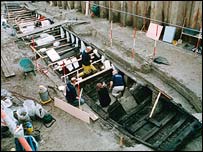
The vessel is currently being excavated by archaeologists from the bottom of Heldammer Stroom, an offshoot of the old course of the River Rhine near the city of Utrecht. First discovered in 1997, it is said to be beautifully preserved.
"It's very special," said Mr Andre Van Holk, the maritime archaeologist heading the research team.
"Most ships that have been found so far were deliberately stripped and sunk to fortify riverbanks and this is the first one that seems to have sunk due to natural causes."
Combat gear
Although the original riverbed silted up centuries ago, the barge has stayed waterlogged for nearly 2,000 years, preserving the vessel and its contents.
 Recovered artefacts: Pottery, a crowbar, plane and an axe |
It is 25 metres long and 2.7 m wide, and is the first to be found with a cabin containing an entire inventory of items that have been fully preserved - from the captain's kitchen, bed and chest, down to the contents of his cupboard. Since previous excavations have revealed the existence of a number of watchtowers and fortresses in the area, the archaeologists believe that this barge will provide insights into how the Romans organised their defence systems.
"We've found indications of military soldiers on board, from the spiked shoes that they normally used, to lance points and axes: standard equipment of the Roman soldier," said Holk.
Future exhibition
The archaeologists plan to lift the barge this month and transport it to the National Institute of Maritime Archaeology in Lelystad, where it will be put in a huge tank containing a special solution for a period of about two years.
This will make the wood durable so that the ship can be displayed later.
"It's the most fascinating find of my working career," said Holk.
"When you consider the fact that only four whole Roman planes (used to smooth wood) have been found in the entire world and that we have found the same number of planes already on this one site, you begin to appreciate the significance of this discovery."
The archaeologists working on the project are from Nisa, the Dutch Institute for Maritime Archaeology, and ROB, the state archaeological soil research department of the Netherlands.


 One-Minute World News
  News services

 E-mail this to a friend
  Printable version
 Enlarge image