By Dr David Whitehouse
BBC News Online science editor |

A pulsar is a spinning neutron star producing powerful beams of radiation that sweep space like a searchlight.
It is called the black widow because the pulsar is devouring a companion star.
The way the radiation and particles coming off the star collide with interstellar gas is helping astronomers understand how these relatively compact cosmic objects work.
Second wave
Known officially as pulsar B1957+20, the black widow is travelling through the galaxy at almost a million kilometres per hour, creating a shockwave in the surrounding gas that is visible in optical telescopes.
But by making observations in the X-ray region of the spectrum, the Chandra telescope shows a second shockwave.
 An artist's impression of the pulsar travelling through space and the associated shockwaves |
This secondary shockwave is created from pressure that sweeps the wind back from the pulsar to form a cocoon of high-energy particles. "This star has had an incredible journey," says Bryan Gaensler, of the Harvard-Smithsonian Center for Astrophysics, in Cambridge, Massachusetts, US.
"It was born in a supernova explosion as a young and energetic pulsar, but after a few million years grew old and slow and faded from view.
"Over the next few hundred million years, this dead pulsar had material dumped on it by its companion, and the pulsar's magnetic field has been dramatically reduced."
Rejuvenated star
Astronomers believe that millisecond pulsars are very old neutron stars that have been spun up by infalling material from their stellar companions.
"This pulsar has been through hell, yet somehow it's still able to generate high-energy particles just like its younger brethren," says Gaensler.
The new data show that this billion-year-old rejuvenated pulsar, that spins almost a thousand times a second, is an efficient generator of a high-speed flow of matter and antimatter particles.
"This is the first detection of a double-shock structure around a pulsar," says Benjamin Stappers, of the Dutch Organization for Research in Astronomy.
"It should enable astronomers to test theories of the dynamics of pulsar winds and their interaction with their environment," he says.


 One-Minute World News
  News services
 Email this to a friend
  Printable version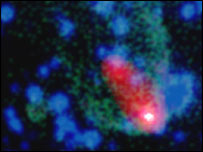

 Enlarge image