|
 |
 | | | | | | ||||||||||||||||||||||||||||||||||||||||||||||||||||||||||||||||||||||||||||||||||||||||||||||||||||||||||||||||||||||||||||||||||||||||||||||||
| | | You are in: Science/Nature | ||||||||||||||||||||||||||||||||||||||||||||||||||||||||||||||||||||||||||||||||||||||||||||||||||||||||||||||||||||||||||||||||||||||||||||||||||
|
| | Monday, 2 December, 2002, 18:55 GMT East meets West in space 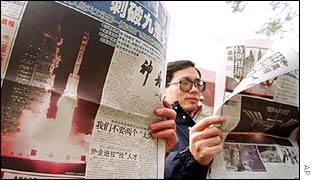 Space is big news in China
A team at London's Imperial College is building instruments for experiments to explore the effects of the Sun on the Earth's magnetic bubble. The mission, known as Double Star, is a joint venture between the European Space Agency (Esa) and the Chinese National Space Agency.
The success of the project is seen as crucial to China's ambitions to become a major player in space. Chris Carr is principal investigator for the magnetometer instrument being built by Imperial College. He told BBC News Online: "This is the new China collaborating on the world scene in science which is something they haven't really done in the past for various political reasons. "It's politically significant that the Chinese are doing these collaborations to open up their space industry to the West. "They are aiming to be the third nation to put a man in space. They're going to do that pretty quickly, in the next 2-3 years." Six satellites Double Star will be the first mission that China has launched to explore the magnetic bubble around the Earth known as the magnetosphere. The two satellites will fly in complementary orbits around the Earth, providing simultaneous data about the changing magnetic field.
They will complement Esa's four Cluster satellites, which are already flying, and should increase the scientific return from both missions. An agreement was reached to develop Double Star jointly in July 2001 in a move designed to pave the way for future collaborations between the two space agencies. More than 30 scientists from the Chinese Academy of Sciences visited London last month to test whether the "brain" of the satellite could "talk" with the European science instruments. Ambitious schedule The visit proved very successful and was a good chance to exchange experience and culture in engineering, says Professor Ji Wu. "Double Star is a joint space programme between China and Europe," he adds. "We are happy to be involved into this mission and particularly to be the interface with the European experiments." Space engineers at Imperial are now validating their instrument's design to ensure it is capable of withstanding the extreme environment of space. But they are up against a very tight deadline. "By autumn next year we have to have a flight instrument available for the first spacecraft," says technical manager Patrick Brown. "The schedule's very ambitious from our point of view." | | See also:  06 Dec 02 | Science/Nature 21 May 02 | Science/Nature 20 May 02 | Science/Nature 01 Apr 02 | Science/Nature 25 Mar 02 | Science/Nature 23 Nov 01 | Asia-Pacific Internet links: The BBC is not responsible for the content of external internet sites Top Science/Nature stories now: Links to more Science/Nature stories are at the foot of the page. | ||||||||||||||||||||||||||||||||||||||||||||||||||||||||||||||||||||||||||||||||||||||||||||||||||||||||||||||||||||||||||||||||||||||||||||||||
| |
|  E-mail this story to a friend E-mail this story to a friend |
| |
| Links to more Science/Nature stories |
| | | ||
 | ||||
 | | Back to top
| ||
| ---------------------------------------------------------------------------------- To BBC Sport>> | To BBC Weather>> | To BBC World Service>> ---------------------------------------------------------------------------------- © MMIII | News Sources | Privacy |