|
 |
 | | | | | | |||||||||||||||||||||||||||||||||||||||||||||||||||||||||||||||||||||||||||||||||||||||||||||||||||||||||||||||||||||||||||||||||||||||||||
| | | You are in: Science/Nature | |||||||||||||||||||||||||||||||||||||||||||||||||||||||||||||||||||||||||||||||||||||||||||||||||||||||||||||||||||||||||||||||||||||||||||||
|
| | Tuesday, 26 November, 2002, 03:26 GMT GM rice can tough it out 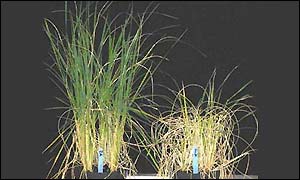 The rice plant on the left has been genetically modified A new genetically engineered variety of rice, which can grow in all types of conditions, has been developed by scientists in the United States and Korea.
The genes allow the rice to maintain yields even if it is stressed, by cold, drought and high salt levels. The sugar leaves the chemical composition of the rice grains unchanged. It is hoped the new crop will help farmers in developing countries be more productive on poor land, increasing yields by up to 20%. Better yields As the word's population continues to rise, many scientists are looking to genetic engineering to improve food production. One approach is to engineer plants that will thrive on difficult land conditions.
But the latest research from Professor Ray Wu, at Cornell University in New York, and colleagues could see millions of hectares of low-yield farmland experiencing improved production. Stabilising compound The key to making the research team's extremely hardy rice is a type of sugar. Trehalose helps stabilise biological molecules - lipids, enzymes and other proteins - in organisms that are experiencing environmental stress. The sugar is naturally found in fungi, bacteria and some invertebrate animals. It is also found in drought-resistant plants, which it protects from damage during desiccation. However, until now, scientists have been unable to transfer the genes that code for trehalose into other plants without damaging them. In previous studies, trehalose genes were taken from yeast or the bacterium E. coli - but the GM plants failed to grow properly. Fusion genes The team worked on the basmati (indica) rice plant, the most common rice variety in the world. It inserted two genes from the bacterium E. coli into the rice genome. But to avoid the problems previously experienced, the scientists also inserted a "fusion" gene. This combines the two trehalose genes together, making the sugar easier to work with. The team also added a special promoter - a starting gene - in front of the trehalose genes, which ensures the sugar code is only switched on when the plant is under stress. By modifying the rice in this special way, the plant develops normally and is more tolerant to environmental pressures. The sugar also helps plant cells regain their efficiency when environmental conditions improve. Naturally occurring Professor Ray Wu said there was no danger to the environment from this new form of GM rice. He told BBC News Online: "The genes [for trehalose] are already present in wild rice and domestic rice in smaller quantities. Even if it did get into wild rice, it would just become more tolerant." So far, the scientists only have preliminary results, but they estimate that if their rice is grown commercially it would increase yields by up to 20%. "We will be able to feed many more people if this can be realised in the field," Professor Wu said. Maize and barley Other crops from the grass family - like corn (maize), wheat, barley, sugarcane and rye - are closely related to rice. In theory, they too could be modified using the same techniques. Professor Wu said that work was already under way on corn and wheat to try to make them more tolerant to droughts, salinity and extreme temperatures. "In principle, it is likely to happen, but it has to be proved experimentally." The technology will be placed in the public domain, rather than being sold to a commercial seed company, so that improved crop varieties can be grown in areas of the world where soil and weather conditions make it difficult to farm rice. The research is published in the journal Proceedings of the National Academy of Sciences. | |
See also:  13 Dec 00 | Science/Nature 14 Jan 00 | Science/Nature Internet links: The BBC is not responsible for the content of external internet sites Top Science/Nature stories now: Links to more Science/Nature stories are at the foot of the page. | |||||||||||||||||||||||||||||||||||||||||||||||||||||||||||||||||||||||||||||||||||||||||||||||||||||||||||||||||||||||||||||||||||||||||||
| |
|  E-mail this story to a friend E-mail this story to a friend |
| |
| Links to more Science/Nature stories |
| | | ||
 | ||||
 | | Back to top
| ||
| ---------------------------------------------------------------------------------- To BBC Sport>> | To BBC Weather>> | To BBC World Service>> ---------------------------------------------------------------------------------- © MMIII | News Sources | Privacy |