|
 |
 | | | | | | ||||||||||||||||||||||||||||||||||||||||||||||||||||||||||||||||||||||||||||||||||||||||||||||||||||||||||||||||||||||||||||||||||||||||||||||||
| | | You are in: Science/Nature | ||||||||||||||||||||||||||||||||||||||||||||||||||||||||||||||||||||||||||||||||||||||||||||||||||||||||||||||||||||||||||||||||||||||||||||||||||
|
| | Monday, 4 November, 2002, 07:45 GMT Alaska hit by year's strongest quake 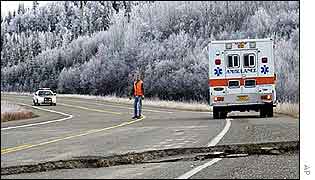 The massive quake damaged three major highways
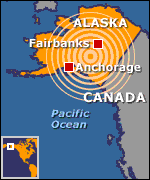
United States Geological Survey spokeswoman Carolyn Bell says the epicentre of the quake was 120 kilometres (75 miles) south of Fairbanks and about 280 km (175 miles) northeast of Anchorage. It occurred just after 1300 local time (2200 GMT). Pipeline checks The earthquake occurred on a segment of the Denali geological fault that runs through Alaska. It was in the same area as a previous magnitude 6.7 quake that struck on 23 October. "The only damage I know of right now is serious cracks up to a foot wide and earth displacement in the Denali Park's highways," Bell says.
"It's quite large. There's going to be damage to buildings," she added. The Alaska Earthquake Information Center said the earthquake had been felt strongly throughout the state. The quake triggered the automatic protection system on the Trans-Alaskan oil pipeline. Engineers manually shut it down a short time later. A helicopter survey later gave the pipeline the all clear. 'Wake-up call' There are preliminary reports of light damage in communities throughout central Alaska. Paul Whitmore, a geophysicist at the West Coast Alaska Tsunami Warning Center in Palmer, Alaska, near Anchorage, said the quake "almost knocked me off my feet." "I ran out to the car and it was hard to stand up. That's the first earthquake I ever felt outside. That's pretty unusual. We were a long way from the epicentre," he said. "Sometimes we see that after big earthquakes; the seismicity in the whole region may tick up. "This is a good case for people to review their safety plans, make sure their bookcases are attached to the walls and so forth. It's really a good wake up call," he added. Quake records The Denali fault is a major, seismically active strike-slip fault that cuts through Alaska, slicing the rugged Alaska Range of mountains and bounding the precipitous north face of Mt McKinley, the highest peak in North America. Denali is the local name for McKinley. Streams and glacial moraines crossing the fault have been displaced because of its movement in the past. Some geologists believe that two sides of the fault-line have slipped over 400 km (250 miles) in the past 200 million years. Scientists have believed that this section of the Denali fault has the potential of generating earthquakes as large as magnitude class 8, but none that large have been recorded in historic time, since the beginning of the last century. The largest earthquake ever recorded in North America, a 9.3, also occurred in Alaska, in 1964. | | See also:  03 Nov 02 | Europe 19 Jul 02 | Science/Nature 22 Jun 02 | In Depth Internet links: The BBC is not responsible for the content of external internet sites Top Science/Nature stories now: Links to more Science/Nature stories are at the foot of the page. | ||||||||||||||||||||||||||||||||||||||||||||||||||||||||||||||||||||||||||||||||||||||||||||||||||||||||||||||||||||||||||||||||||||||||||||||||
| |
|  E-mail this story to a friend E-mail this story to a friend |
| |
| Links to more Science/Nature stories |
| | | ||
 | ||||
 | | Back to top
| ||
| ---------------------------------------------------------------------------------- To BBC Sport>> | To BBC Weather>> | To BBC World Service>> ---------------------------------------------------------------------------------- © MMIII | News Sources | Privacy |