
|
 |
 | | | | | | |||||||||||||||||||||||||||||||||||||||||||||||||||||||||||||||||||||||||||||||||||||||||||||||||||||||||||||||||||||||||||||||||||||||||||||||||
| | | You are in: Science/Nature | |||||||||||||||||||||||||||||||||||||||||||||||||||||||||||||||||||||||||||||||||||||||||||||||||||||||||||||||||||||||||||||||||||||||||||||||||||
|
| | Monday, 30 September, 2002, 21:02 GMT 22:02 UK Life's not so complicated web 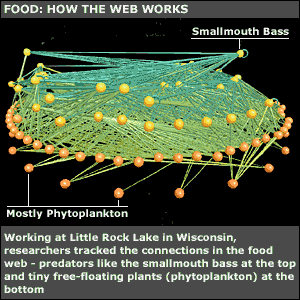
They found species are much more closely linked to each other than previously thought. This may have implications for conservation and biodiversity, as the consequences of species extinction are likely to be more widely felt than was realised. Food theory Two studies published in the Proceedings of the National Academy of Sciences (PNAS) combine network analysis with real-world ecological data to search for patterns in food webs: the chain of who eats whom in a complex biological system. Close relationships like that between predator and prey clearly link species, but there appear also to be similar links between species which are not obviously connected. Dr Neo Martinez and colleagues from San Francisco State University (SFSU), and Alberto Barabasi from the University of Notre Dame, both US, examined the number of links between species in food webs of different sizes. They found over 95% of species from a variety of terrestrial and aquatic habitats were within three links of each other, with the average number of links being just two. Ecologists used to think that within large communities species would be four or more links away from each other, and therefore unlikely to affect others in the event of extinction, for example. Sensitive parts This research shows few, if any, species in the same community are four links apart. This means that invasions, extinctions and biodiversity loss may affect many more species than previously thought, because so few species will be far enough apart not to be affected.
"Food webs may largely conform to simple equations. Finding them would greatly help us focus on the parts of the system most sensitive to biodiversity loss. "People should not be so confident that they can predict the consequences of species extinctions or invasions, like in biocontrol. "The law of unintended consequences appears particularly applicable to large complex ecological systems." World of cliques Some scientists are coming round to this new way of thinking. "They are probably right on this," says Dr Jane Memmott, an ecologist specialising in food webs and biocontrol from the University of Bristol, UK. "If it makes people more careful of damaging the environment, then it is of good practical use." She adds that more good quality field data is needed to confirm and complement the theory. The US researchers also investigated whether food webs conformed to what is called the "small world" phenomenon, the "six degrees of separation" found in a number of biological, social and technological networks, from the neural cells of worms to the pages of the worldwide web. "Small worlds" typically have numbers of clique-like clusters of nodes a short distance apart. Useful tools As in social groups, cliques tend to form in which every member knows all or most of the other members. The researchers used a measure called the clustering coefficient that describes how clique-like a network is. In some small worlds, they found, most nodes had relatively few links, but a few were the super-connected hubs of the system. Such networks are obviously very vulnerable if the lose the rare highly-connected nodes. But analysis of 16 complex food webs with between 25 and 172 nodes from various habitats showed most were not small worlds and did not resemble the technological networks such as the web and the US power grid. "Physicists want to see one universal type," says Dr Martinez. "Ecologists want to say every habitat and system is different. "We're treading the middle ground, which some see as a no-man's land. Others like us see it as a much more persuasive and scientifically useful claim than either of the extremes." | | See also:  24 Aug 01 | Science/Nature 28 Sep 00 | Science/Nature Internet links: The BBC is not responsible for the content of external internet sites Top Science/Nature stories now: Links to more Science/Nature stories are at the foot of the page. | |||||||||||||||||||||||||||||||||||||||||||||||||||||||||||||||||||||||||||||||||||||||||||||||||||||||||||||||||||||||||||||||||||||||||||||||||
| |
|  E-mail this story to a friend E-mail this story to a friend |
| |
| Links to more Science/Nature stories |
| | | ||
 | ||||
 | | Back to top
| ||
| ---------------------------------------------------------------------------------- To BBC Sport>> | To BBC Weather>> | To BBC World Service>> ---------------------------------------------------------------------------------- © MMIII | News Sources | Privacy |






