
|
 |
 | | | | | |||||||||||||||||||||||||||
| | You are in: Sci/Tech | |||||||||||||||||||||||||||||
 | | Monday, 24 June, 2002, 09:28 GMT 10:28 UK Destination: Comet 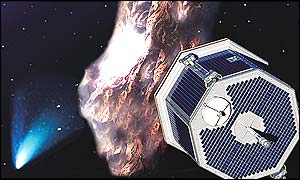 Comet flyby: A daring goal for space scientists
On 1 July the American space agency (Nasa) will send up a probe destined to fly past two of the icy bodies. The Comet Nucleus Tour (Contour) will be followed next January by the launch of a daring European Space Agency (Esa) mission. Rosetta will chase a speeding comet and then, for the first time ever, try to land on it. There are two more Nasa comet missions in the pipeline. One of them - Deep Impact - will blast a crater the size of a football field out of a comet to study its core. It is due to take off early next year. The other - Stardust - is designed to snatch a sample of dust from around a comet. The probe was launched in 1999 and is already on its way. 'Time capsules' Scientists are interested in comets because they represent the primitive building blocks of the Solar System. "If you want to study the early history of the Solar System it's no good looking at planets like the Earth and Moon," says Dr John Davies, an astronomer at the Royal Observatory, Edinburgh.
There are other driving forces behind the new endeavours. Manoeuvring a spacecraft around a comet and then landing on it represents a leap in technology that has only just become possible. Space agencies are also looking for destinations other than planets, many of which have already been explored. Golden age Dr Andrew Coates, of University College London's Mullard Space Science Laboratory, says the new missions are exciting because they will use several techniques and look at different comets. "These ranges of missions with different types of techniques are leading on to what's going to be a golden age of comet exploration in the next 10 years or so," he told BBC News Online.
He also worked on Esa's Giotto mission, which flew by Comet Halley in March 1986. He sees the latest Esa mission as a natural progression. "Rosetta really is the jewel in the crown of cometary exploration in the next few years," says Dr Coates. "It's the logical next step after Giotto, which flew past a comet at high speed. "This really takes the science on one step further." | | See also:  Internet links: The BBC is not responsible for the content of external internet sites Top Sci/Tech stories now:  Links to more Sci/Tech stories are at the foot of the page. | |||||||||||||||||||||||||||
|
Links to more Sci/Tech stories |
 | | ^^ Back to top News Front Page | World | UK | UK Politics | Business | Sci/Tech | Health | Education | Entertainment | Talking Point | In Depth | AudioVideo ---------------------------------------------------------------------------------- To BBC Sport>> | To BBC Weather>> ---------------------------------------------------------------------------------- © MMIII|News Sources|Privacy  |


 E-mail this story to a friend