|
 |
 | | | | | | |||||||||||||||||||||||||||||||||||||||||||||||||||||||||||||||||||||||||||||||||||||||||||||||||||||||||||||||||||||||||||||||||||||||||||||||||||||||||||||||||||||||||||||||||||||||
| | | You are in: Science/Nature | |||||||||||||||||||||||||||||||||||||||||||||||||||||||||||||||||||||||||||||||||||||||||||||||||||||||||||||||||||||||||||||||||||||||||||||||||||||||||||||||||||||||||||||||||||||||||
|
| | Thursday, 13 June, 2002, 17:00 GMT 18:00 UK Astronomers hail planetary discovery

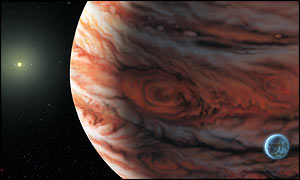
It reminds them of home, say the researchers.
This brings the number of known exoplanets - planets outside our own system - to over 100. Included in the new finds is the smallest exoplanet yet. It is only 40 times more massive than Earth. Detecting Earth-sized planets is probably not possible using current ground-based techniques. That will have to wait for a new generation of satellite observatories, due in the next decade. 'We are getting close' Veteran planet hunters Geoffrey Marcy and Paul Butler are gradually finding planetary systems that are more and more like the one in which the Earth resides.
The smallest planet ever detected circles the star HD49674 in the constellation Auriga, at a distance of about one-twentieth the distance from the Earth to the Sun. Its mass is about 15% that of Jupiter in addition to it being 40 times that of Earth. Getting closer The planetary system that superficially looks like ours orbits a star called 55 Cancri in the constellation Cancer. It was already known to have one planet orbiting it, also discovered by Butler and Marcy in 1996. 55 Cancri's first planet is a gas giant slightly smaller than Jupiter that orbits the star in 14.6 days, at a distance only one-tenth that from the Earth to the Sun. The newly discovered planet orbits 55 Cancri, a star 41 light-years away, about five times further away than the first planet, making this planetary system similar in proportion to ours. The new planet's slightly elongated orbit takes it around the star in about 13 years, comparable to Jupiter's orbital period of 11.86 years. It is 3.5 to 5 times the mass of Jupiter. "We haven't yet found an exact solar system analog, which would have a circular orbit and a mass closer to that of Jupiter. But this shows we are getting close," says Butler. Prime candidate Calculations made by Greg Laughlin of the University of California at Santa Cruz show that an Earth-sized planet could survive in a stable orbit between the two gas giants. But because current techniques are not able to detect an Earth-sized planet orbiting another star, the existence of any such planet around 55 Cancri is speculative. "The existence of analogs to our solar system adds urgency to missions capable of detecting Earth-sized planets - first, the Space Interferometry Mission and then the Terrestrial Planet Finder," said Charles Beichman, the chief scientist of the American space agency's (Nasa) Origins Program. And British planet hunter Dr Hugh Jones, of Liverpool John Moores University, said: "Most of the planets found previously are like distant cousins to the planets in our own Solar System, but now we are finding ones much more like ours. We are getting closer to our brothers and sisters." A detailed look at the observations suggests that there may be more objects orbiting 55 Cancri because the two known planets do not explain all the data. One possible explanation is a Saturn-mass planet orbiting the star as well. | |
See also:  11 Jan 01 | Science/Nature 15 Oct 01 | Science/Nature 07 Aug 00 | Science/Nature Internet links: The BBC is not responsible for the content of external internet sites Top Science/Nature stories now: Links to more Science/Nature stories are at the foot of the page. | |||||||||||||||||||||||||||||||||||||||||||||||||||||||||||||||||||||||||||||||||||||||||||||||||||||||||||||||||||||||||||||||||||||||||||||||||||||||||||||||||||||||||||||||||||||||
| |
|  E-mail this story to a friend E-mail this story to a friend |
| |
| Links to more Science/Nature stories |
| | | ||
 | ||||
 | | Back to top
| ||
| ---------------------------------------------------------------------------------- To BBC Sport>> | To BBC Weather>> | To BBC World Service>> ---------------------------------------------------------------------------------- © MMIII | News Sources | Privacy |