|
 |
 | | | | | | |||||||||||||||||||||||||||||||||||||||||||||||||||||||||||||||||||||||||||||||||||||||||||||||||||||||||||||||||||||||||||||||||||||||||||||||||||||||||||||||||||||||||||||||||||||||||||||||||||||
| | | You are in: Science/Nature | |||||||||||||||||||||||||||||||||||||||||||||||||||||||||||||||||||||||||||||||||||||||||||||||||||||||||||||||||||||||||||||||||||||||||||||||||||||||||||||||||||||||||||||||||||||||||||||||||||||||
|
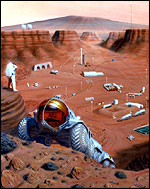
| | Monday, 27 May, 2002, 14:18 GMT 15:18 UK Manned Mars mission some way off Nasa has a manned mission as a long-term aim
The agency will certainly not make any such commitment this week when the latest study results from the Mars Odyssey probe are officially published in Science magazine.
For many, the promise of the Red Planet, and our generation's place in history, is only partially fulfilled if we do not eventually send people to Mars. When and how are secondary issues. Somehow, there is something deep within our nature that will be unsatisfied if we just let the robots do it all. Political will Be assured, a manned mission will take time to devise and execute - something like 20 years in the current climate. That means the first person to walk on Mars is probably currently in his or her teens.
But then, hopefully, the commitment will also last longer than for the moonshots. Getting to Mars will certainly be much more difficult. The Moon is only three days away; Mars is 300. A round trip will take two and a half to three years and require a substantial stay on the Martian surface. Return ticket Recycling will be a major issue. A spacecraft cannot possibly carry all the food and water it needs for a crew of several. Our current recycling technology is good - but not good enough.
The crew will have to be specially selected to be able to cope. Should it be a mixed crew or all men, or all women? And what of the technologies these emissaries will need to use when they land on Mars? Knowing that vast swathes of water-ice just below the surface are there is one thing - being able to dig it up and turn it into fit drinking water or rocket fuel is another matter altogether. All people And remember, there will be no second chances on Mars. If the crew is relying on technology to manufacture its rocket fuel to get home from the hydrogen and oxygen locked up in the Martian ice then it had better work - first time. One question intrigues me: who should put the first human footprint on Mars? Should it be an American - as surely only the US will be in a position to mount such a mission for a long time to come? One appealing suggestion I heard a few years ago is that included in any crew should be a representative of the poorest nation on Earth and that this individual should make the first footfall on another world as a pledge to the poor of planet Earth. And if this person did become the first human to stand on the red soil of Mars, what would they say? Discuss. Your views: We already have the technology for a mission to Mars. I would volunteer to go if someone was to send a mission - even if it's one-way, it's an opportunity of a lifetime! Where would mankind be today had we not taken any risks in the past?
Peter Hope, Ireland Instead of circling the Earth, the International Space Station should be put into an orbit between Earth and Mars. This could then be used to carry explorers on unlimited journeys to and from Mars, and actually make the vast expense worthwhile. It's sexy, exciting and the stuff of dreams - but how, with nations lining up to annihilate each other with weapons of mass destruction, millions dying from famine, drought, disease, slavery, oppression and global warming - can we justify spending the hundreds of billions of dollars it would take just to put one or two lucky individuals on Mars' surface? We should be confronting and solving our problems in the here and now, not looking for ways for a handful of the "great and good" to run away from them.
James C Becknell, US What makes this discovery most interesting is the possibility of life. Many people would feel threatened with sharing this universe with strangers. Let's just hope that if that does happen, if they do find life, humans will not move towards what seems to be their instinctive desire to murder and dissect. Wonderful; one of the most important discoveries ever made. With water found at our closest planet, the probability that life exists elsewhere in our galaxy increases immeasurably.
Craig Grannell, Iceland I don't think bringing samples back is a good idea. What about the risk of deadly Martian bacteria which grow slowly on Mars, but which, on entering the Earth's atmosphere, grow incredibly quickly, and wipe out the entire world population? Maybe I've seen too many Martian movies? It's nice to see that there is even more water than we had dared hope for. I think I'd now be suppressed if evidence of live did not come to light. However, the idea of NASA launching a manned mission within twenty years is currently laughable. Look how bad they are at managing the ISS. NASA also don't seem to admit that to be remotely safe, a Mars mission will require double or triple redundancy of all aspects of it. This has never been factored into the more optimistic cost projections - it will cost probably around a trillion dollars when we finally do go.
Bubble/Slide, UK I say great. Let's go and colonise Mars. The property prices are bound to be cheaper than London. Amazing news! But I think humans shouldn't land on Mars at all. They could destroy a life-form by their mere presence on the planet and destroy any future prospects for any existing life there evolving into higher forms or even intelligent life. I am thinking here in terms of an evolutionary time scale. Monitor but do not enter should be the order of millions of years to come.
Roy, US It shows that if you look long enough and believe hard enough you can prove anything. I fail to see why this is such an exciting discovery. Mars is freezing cold with a thin atmosphere and not much use for anything, and now we discover it has a polar ice cap...mmm not exactly Bermuda! Another small step on the journey to the stars but, "Sometimes I think the surest sign that intelligent life exists elsewhere in the Universe is that none of it has tried to contact us." Quick! Let's go there, refuse to come back and claim Mars as a sovereign state. The Welsh Republic of Mars. I'll be president!
Jonathan Fish, France | |
See also:  22 May 02 | Science/Nature Internet links: The BBC is not responsible for the content of external internet sites Top Science/Nature stories now: Links to more Science/Nature stories are at the foot of the page. | |||||||||||||||||||||||||||||||||||||||||||||||||||||||||||||||||||||||||||||||||||||||||||||||||||||||||||||||||||||||||||||||||||||||||||||||||||||||||||||||||||||||||||||||||||||||||||||||||||||
| |
|  E-mail this story to a friend E-mail this story to a friend |
| |
| Links to more Science/Nature stories |
| | | ||
 | ||||
 | | Back to top
| ||
| ---------------------------------------------------------------------------------- To BBC Sport>> | To BBC Weather>> | To BBC World Service>> ---------------------------------------------------------------------------------- © MMIII | News Sources | Privacy |