
|
 |
 | | | | | |||||||||||||||||||||||
| | You are in: Sci/Tech | |||||||||||||||||||||||||
 | | Thursday, 23 May, 2002, 18:40 GMT 19:40 UK DNA traces found in ancient rock 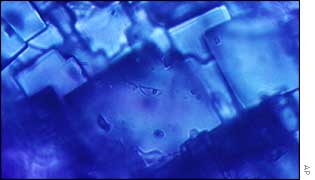 DNA traces were found in ancient rock salt
There have been many reports of discoveries of ancient DNA, but most have been dogged by suspicions of contamination. Now, Bill Grant of the University of Leicester, UK, says he is sure the samples his team found are from genuine ancient rock. They looked at tiny samples of rock salt from Poland, the United States and Thailand - some of it thought to 425 million years old. Dr Grant and his colleagues drilled into the tiny lumps of rock salt with a special laser. In each case, they took care to find a piece of the rock which was genuinely ancient rather than a piece contaminated by more modern water seepage. Scientific controversy "We took that piece out, being as careful as we could to avoid contamination. Then we looked for DNA and we found it," he told BBC News Online. Dr Grant is conscious of the scrutiny his work will receive after the dozens of reports which have been disputed over the years. "There are well known and respected people who believe that DNA can't survive more than 100,000 years or so. "Its basic chemistry means that the bonds in it fall apart," he said. But such experts had based their work on DNA kept in relatively dilute liquids and little work had been done on how DNA survived in extremely strong salt solutions, he said. "We think that salt has particular preservation qualities," he added. The bacterial DNA traces his team found were in tiny pockets called fluid inclusions created as the rock salt formed. Dr Grant and his colleagues describe their work in the journal Nature. | | See also:  Internet links: The BBC is not responsible for the content of external internet sites Top Sci/Tech stories now:  Links to more Sci/Tech stories are at the foot of the page. | |||||||||||||||||||||||
|
Links to more Sci/Tech stories |
 | | ^^ Back to top News Front Page | World | UK | UK Politics | Business | Sci/Tech | Health | Education | Entertainment | Talking Point | In Depth | AudioVideo ---------------------------------------------------------------------------------- To BBC Sport>> | To BBC Weather>> ---------------------------------------------------------------------------------- © MMIII|News Sources|Privacy  |


 E-mail this story to a friend