
|
 |
 | | | | | |||||||||||||||||
| | You are in: Sci/Tech | |||||||||||||||||||
 | | Thursday, 23 May, 2002, 14:31 GMT 15:31 UK 'Solar cloth' offers moveable power 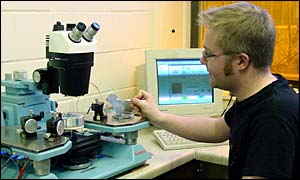 Testing a polymer layer at Heriot-Watt Textiles which incorporate solar cells could allow some travellers to dispense with batteries altogether, predict scientists. Researchers at the School of Textiles at Heriot-Watt University in Scotland say they may be able to produce fabrics carrying solar cells. These, they suggest, could be rolled up and carried to remote locations - perhaps to be used as a source of power for fireman or soldiers. However, the limited space available on clothing means that jackets which provide power for mobile phones and laptops may still be some way off. Traditional solar cells use layers of silicon, sandwiched between metal contacts on each side. Electron movement Solar cells work because silicon releases electrons in response to photons in the sun's rays. If one layer of silicon is treated to make it rich in electrons, and the other treated to make it contain far fewer, then a flow, or electric current can be produced between the two. Most solar panels are made using crystals of silicon - which make them both expensive to produce, relatively thick, and totally inflexible.
He believes that a workable cell can be created by depositing thin films of silicon on to a glass substrate. These films - only a few microns thick - could in theory be laid on to fabrics, or clothing fibres prior to the weaving process. Professor Wilson told BBC News Online that the textiles could be efficient enough to produce 100 watts per square metre in very sunny countries. He said: "We have completed a year-long feasibility study and we believe we can put the film on to fibres, and that it will work pretty well when it is there. "However, the surface area of clothing, at the current level of efficiency, is probably only enough to power tiny sensors, rather than personal electronic equipment. "We are looking more towards a tent or tarpaulin sized solar panel that can be rolled up and transported easily." He said that improvements in cell efficiency - perhaps offered by the latest crystalline silicon nanotubes - might allow a patch on the back of a jacket, or the side of a bag, to power a laptop or trickle-charge a mobile. "I can certainly see this happening in the future." Cheaper cells While a breakthrough in this area would potentially produce convenient and moveable solar power, other UK scientists are hunting ways to cut down the cost, so that solar power becomes a more affordable option. Most of the cost comes from the silicon itself, particularly when used in thick, crystalline layers.
She is working so-called Gr�tzel Cells, invented in the 1990s by an Austrian scientist, which use far cheaper titanium dioxide instead. Particles of titanium dioxide are coated with a photosensitive dye, and suspended between two electrodes in a solution containing iodine ions. When this dye is exposed to light energy, some of its electrons jump on to the titanium dioxide particles, which then are attracted to one of the electrodes. At the same time, the iodine ions transport electrons back from the other electrode to replenish the dye particles. This creates a flow of electrons around the circuit. Researchers say it is only slightly less efficient than a silicon-based cell - and as its principal ingredient is cheap, it represents a potentially affordable technology for developing countries. | | See also:  Internet links: The BBC is not responsible for the content of external internet sites Top Sci/Tech stories now:  Links to more Sci/Tech stories are at the foot of the page. | |||||||||||||||||
|
Links to more Sci/Tech stories |
 | | ^^ Back to top News Front Page | World | UK | UK Politics | Business | Sci/Tech | Health | Education | Entertainment | Talking Point | In Depth | AudioVideo ---------------------------------------------------------------------------------- To BBC Sport>> | To BBC Weather>> ---------------------------------------------------------------------------------- © MMIII|News Sources|Privacy  |


 E-mail this story to a friend