
|
 |
 | | | | | |||||||||||||||||||||||||||||||||||||||||||||
| | You are in: Sci/Tech | |||||||||||||||||||||||||||||||||||||||||||||||
 | | Monday, 25 March, 2002, 09:06 GMT Child soldiers to swap guns for PCs 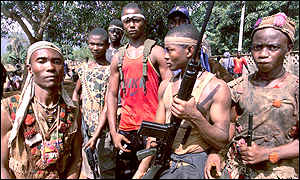 Software programmers of the future?
A Sierra Leonean entrepreneur, Francis Steven George, is planning to set up a vocational training centre to teach computer and programming skills to the former rebels. "There are thousands of young people who were taken away from school during the war years and now that the fighting is finished, the question of what to do with them has to be addressed," said Mr George. He hopes that the project will be the first step towards developing West Africa as a regional hub for the computer industry. Reign of terror It is estimated that as many as half of the 15,000 former rebel fighters in Sierra Leone are children. During the mid-1990s, this child army killed, abducted, raped and maimed thousands of their fellow countrymen, famously imposing their reign of terror by hacking off the limbs of victims with machetes.
He believes the best way to rehabilitate these former fighters is to teach them new skills, rather than recruit them into the army or turn them into some sort of paramilitary force. "This would represent one of the best avenues for them because in the next economy, information literacy is going to be the key," he told the BBC programme Go Digital. "If you have a population that is information literate, things like diseases and other problems are going to be able to be tackled in a more serious way than if you have a population that is information illiterate," he said. Regional ambitions Mr George is in the process of putting together the funding for the project. So far, he has won the backing of the Norwegian Government and various private Norwegian groups are interested in providing money for the plan.
Within three years, he hopes to have trained enough people for Sierra Leone to become a centre for the outsourcing of software programming. "Today, everyone goes to India because of the cost advantage. But I think we could do it cheaper and the only thing stopping us is that we don't have the right skills and that is what I want to develop." Damaged economy Developing Sierra Leone as a regional centre for information technology may prove an uphill struggle. Although rich in diamonds, the country's development has been blighted by acute political instability since independence in 1961. The long-running civil war displaced nearly half the country's 4.5 million population and left the economy in ruins. Internet connections are few and only available in the capital, Freetown. Passionate feelings But Mr George is optimistic these obstacles can be overcome by, for example, using satellite links to provide internet access. "From my experience, if you have the right people with the right skills, the infrastructure and all the other elements will quickly fall into place," he said. As a Sierra Leonean living abroad, he is passionate about this project. "It means a lot to me because I left Sierra Leone when it was a very different country to what it is today. "Personally, it means that I will be able to give back something to Sierra Leone that I believe will have very serious repercussions not only for Sierra Leone but also for the region as a whole." | |
See also:  Internet links: The BBC is not responsible for the content of external internet sites Top Sci/Tech stories now:  Links to more Sci/Tech stories are at the foot of the page. | |||||||||||||||||||||||||||||||||||||||||||||
|
Links to more Sci/Tech stories |
 | | ^^ Back to top News Front Page | World | UK | UK Politics | Business | Sci/Tech | Health | Education | Entertainment | Talking Point | In Depth | AudioVideo ---------------------------------------------------------------------------------- To BBC Sport>> | To BBC Weather>> ---------------------------------------------------------------------------------- © MMIII|News Sources|Privacy  |








 E-mail this story to a friend