
|
 |
 | | | | | |||||||||||||||||||||||
| | You are in: Sci/Tech | |||||||||||||||||||||||||
 | | Tuesday, 26 February, 2002, 15:05 GMT Scientists plan Pluto flyby 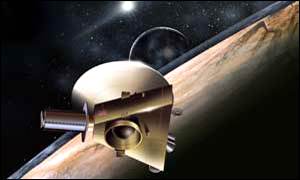 Golden opportunity to study Pluto
Nevertheless, researchers believe the distant planet represents one of the true frontiers in the Solar System that no spacecraft has ever visited - and they know they need to be ready to act swiftly if the money ever does become available. There is a real urgency here. Pluto is moving away from the Sun and unless we get there soon we may miss amazing sights that will not reoccur for almost 250 years. The science could be spectacular; the politicians remain to be convinced. Jupiter first There are two reasons why scientists want to get there as soon as possible. The first has to do with its atmosphere. Since 1989, Pluto has been moving farther from the Sun and as it gets colder its atmosphere will freeze out. Researchers want to arrive while there is a chance to see it. The second reason is to map as much of Pluto and Charon as possible. The longer we wait, the more of Pluto and Charon will be shadowed for decades impeding the spacecraft's ability to take pictures in reflected sunlight. Celestial mechanics say that an opportunity to launch to Pluto by way of Jupiter, which gives it a "gravity kick", occurs in January 2006. But given the lack of commitment about the funding, this does not provide much time to get a probe designed and built. One day only If a mission ever does fly, scientists know what they want to do. From Earth, the spacecraft will head to Jupiter, arriving just over a year later. Passing the Jovian system at 80,500 kilometres per hour (50,000 miles per hour), the probe will move on a trajectory that will arrive at Pluto and Charon as early as 2015. The cameras on the spacecraft will start collecting data on Pluto and Charon a year before it arrives and about three months from the closest approach - when Pluto and Charon are about 160,000 kilometres (100,000 miles) away, the spacecraft can make the first maps. The busiest part of the Pluto-Charon flyby lasts a full Earth-day. On the way in, the spacecraft will make the best global maps of Pluto and Charon in green, blue, red, and a special wavelength that is sensitive to methane frost on the surface. Next object The spacecraft will get as close as about 9,600 kilometres (6,000 miles) from Pluto and about 27,000 kilometres (17,000 miles) from Charon. During the half hour when the spacecraft is closest to Pluto or its moon, it will take close-up pictures in both visible and near-infrared wavelengths. The best pictures of Pluto will depict surface features as small as 60 meters (about 200 feet) across. But even when it has sailed past Pluto the spacecraft's scientific life is far from over. After passing Pluto, it will retarget itself for an encounter with a Kuiper Belt Object (KBO), one of the many large chunks of rock and ice that have been found in the cold outer-reaches of the Solar System in the past decade. Researchers have not targeted a specific KBO yet, but expect to find one or more the spacecraft could reach that are 50-100 km (about 30-60 miles) across. Reflective surface With so much pioneering science that such a probe could do researchers know they can still make a case for the Pluto probe. They just hope that the politicians will listen. Despite their proximity, Pluto and Charon are covered with bright frosts of differing compositions. Water-ice covers Charon, while Pluto's surface is predominantly nitrogen frost with traces of methane and carbon monoxide ices. The Pluto/Charon system has a highly elliptical orbit around the Sun. In 1989, Pluto was as close to the Sun as it gets during its long year - less than 30 astronomical units (AU), or 30 times the distance between Earth and the Sun. That distance nearly doubles just half a Pluto-year later, to 50 AU in 2123. As Pluto recedes from the Sun, much of its thin nitrogen atmosphere will condense as frost on the surface. This periodic reappearance of fresh frost takes place every Pluto-year (248 Earth-years) and is the reason that Pluto is one of the most reflective surfaces in the Solar System. | | See also:  Internet links: The BBC is not responsible for the content of external internet sites Top Sci/Tech stories now:  Links to more Sci/Tech stories are at the foot of the page. | |||||||||||||||||||||||
|
Links to more Sci/Tech stories |
 | | ^^ Back to top News Front Page | World | UK | UK Politics | Business | Sci/Tech | Health | Education | Entertainment | Talking Point | In Depth | AudioVideo ---------------------------------------------------------------------------------- To BBC Sport>> | To BBC Weather>> ---------------------------------------------------------------------------------- © MMIII|News Sources|Privacy  |


 E-mail this story to a friend