
|
 |
 | | | | | |||||||||||||||||||||||||||
| | You are in: Sci/Tech | |||||||||||||||||||||||||||||
 | | Saturday, 16 February, 2002, 07:46 GMT In praise of the barcode 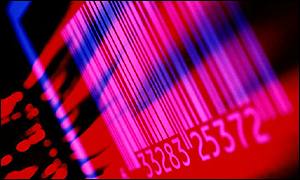 Barcodes conform to strict standards
 The first product to bear a barcode and be scanned by an optical reader was a box of Melrose teabags. The identity of the shopper who bought the teabags is unknown as is the fate of that first barcoded box of beverage bags. By contrast the packet of Wrigley's chewing gum that was the first American product to be barcoded and scanned, admittedly a year or so earlier than in the UK, at Marsh's supermarket in Troy, Ohio now resides in the Smithsonian Museum. It has taken its rightful place alongside other objects of distinction such as the Hope diamond. Change to shopping Andrew Osborne, director of policy and research at e-centre UK that looks after Britain's barcodes, said the event in Spalding was slightly contrived because at that time no products had barcodes on them when they were first made.
Walter Satterthwaite, a consultant to Masterfoods, said shopping for groceries was very different before the advent of barcodes. He said although supermarkets chains such as Tesco and Sainsbury's exist they had not reached the level of influence or size they enjoy today. Sainsbury's, for example, had only 201 stores in 1975. Today it has 460 and the vast majority of those have at least double the floor space of those mid-70s stores. Thanks to barcodes, the number of products in shops has mushroomed.
"Even though you had a small product range you could have a thousand price changes over the weekend because of inflation," he said. In the 19070s UK inflation peaked at 28%, now it hovers around the 2% mark. "Its no wonder they didn't open on a Sunday," he added, "they couldn't not because they were spending all day changing all the prices." Now the average supermarket carries around 25,000 product lines and they can only do that because barcodes make it easy to maintain a database of a store's stock in which prices can be changed with the click of a mouse. Now around 35,000 stores in the UK use barcodes and scanners to keep track of stock. Almost all the makers of the foods and goods we find in stores use them to manage their flow of raw materials and finished products through their factories. "Without barcodes our operations simply would not work," said Robin Kidd, supply chain manager at Nestle UK. Co-ordinated coding schemes Barcodes have now become the global language of business and are standardised and regulated so there is no danger that two companies will pick the same barcode for different products.
The vast majority of the world uses barcode standards drawn up by the European Article Number Association. Everywhere, that is, except the US and Canada, which use their own Universal Product Code that was invented in 1973 by George J Laurer. The two coding schemes work together so there is no chance of confusion. Barcodes are going from strength to strength. They are already widely used by companies who trade electronically and make it very easy to describe the raw materials and products that are being bought and sold. And it does not end there. Reduced size barcodes are now being tested for use on loose goods like fruit to make them easier to price. In the future barcodes will be augmented with radio-frequency identity tags that can be scanned more quickly and can have the information encoded on them updated. At the moment these ID tags are too expensive to use on the goods we buy in supermarkets, but they are being tested for use by manufacturers and distributors who typically buy, sell and move lots of products at a time. Eventually it will make its way to the products on supermarket shelves and then shopping will be a matter of walking in, picking up what you want walking past a radio scanner and then paying. | | See also:  Internet links: The BBC is not responsible for the content of external internet sites Top Sci/Tech stories now:  Links to more Sci/Tech stories are at the foot of the page. | |||||||||||||||||||||||||||
|
Links to more Sci/Tech stories |
 | | ^^ Back to top News Front Page | World | UK | UK Politics | Business | Sci/Tech | Health | Education | Entertainment | Talking Point | In Depth | AudioVideo ---------------------------------------------------------------------------------- To BBC Sport>> | To BBC Weather>> ---------------------------------------------------------------------------------- © MMIII|News Sources|Privacy  |


 E-mail this story to a friend