|
 |
 | | | | | | ||||||||||||||||||||||||||||||||||||||||||||||||||||||||||||||||||||||||||||||||||||||||||||||||||||||||||||||||||||||||||||||||||||||||||||||||||||||||||||||||||||||||||||||||||||||||||||||
| | | You are in: Programmes: Working Lunch: Consuming Issues | ||||||||||||||||||||||||||||||||||||||||||||||||||||||||||||||||||||||||||||||||||||||||||||||||||||||||||||||||||||||||||||||||||||||||||||||||||||||||||||||||||||||||||||||||||||||||||||||||
|
| |  Friday, 14 June, 2002, 14:56 GMT 15:56 UK Friday, 14 June, 2002, 14:56 GMT 15:56 UK Your pension questions answered... 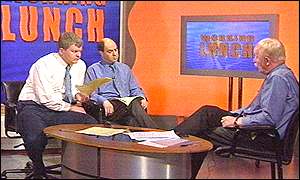 Malcolm fields questions from Adrian and Adam Malcolm McLean from Opas tackles your pension queries. Michael Grimshaw in Essex pays 2% Additional Voluntary Contributions (AVCs) into his company pension scheme and has heard he could use a stakeholder pension instead of AVCs. Would this be cheaper and better? A stakeholder might be a cheaper and a better option than an AVC but Michael needs to obtain details of and compare all the charges involved. First of all, he should check that the "concurrency rules" allow him to take out a stakeholder as a top-up to his pension. He will be able to pay up to �2,808 (�3,600 with the addition of tax relief) into a stakeholder but only if he earns less than �30,000 a year and is not a controlling director of the company. He also needs to establish what charges if any he will incur if he closes down his AVC. Advantage One of the advantages of using a stakeholder in preference to an AVC arrangement is that the former is eligible to be taken in part as tax-free cash on retirement, whereas the AVC can normally only be used for the main pension itself. He should also be aware that if he is allowed to take out a stakeholder, he can do this in addition to his AVC - provided he can afford to do so. In this situation, the maximum is �3,600 for the stakeholder and up to 15% of salary for his main contributions, including the AVC. For further information on this or any aspect of stakeholder pensions contact the Pensions Advisory Service (Opas) helpline on 0845 6012923 or visit the OPAS website Anthony Goring worked in the General Post Office (GPO) from 1954 to 1967 and was in the pension scheme. But he has been told that he does not have a pension in respect of that employment. He wants to know if this is right and if so, why? He wants to know where the money has gone. Unfortunately, Anthony is in the same position as many people who had pension schemes in the 50s, 60s and 70s. It wasn't until 1975 that the government introduced legislation to compel employers to give preserved pension rights to employees who were in the company scheme and left service before reaching retirement age. Nothing In many cases, no matter how long they had been in the scheme, they only got back what they paid in - if the scheme was non-contributory, they got nothing. In Anthony's case, GPO workers were in the civil service pension scheme and thus he got nothing for his 14 years because the rules at that time only gave a leaver the right to a pension if they were over age 50 and had completed 10 years. I assume Anthony was under age 50. As to where the money went, it went nowhere, as the civil service scheme was unfunded - as is still the case today. In funded schemes, the money saved was used to reduce the company's future contributions, although some employers did grant the right to a deferred pension after a number of years. If someone wants guidance as to whether they might have a preserved pension they can contact the Opas Pensions helpline on 0845 6012923. If they can't trace their old pension scheme they should try the Pensions Schemes Registry website or telephone 0191 225 6393. Victor Leong is retiring to Malaysia and wants to know how his state pension will be affected in view of the recent court case brought by a British pensioner living in South Africa. If someone retires to South Africa the pension is frozen at the level payable when they went there or, if already there, when they first drew the pension - this rule was upheld by the courts and applies to other countries too. In Victor's case, this rule also applies to Malaysia. Countries where increases are payable are:- To find out more about how going abroad can affect your state pension, get leaflet GL29, Going Abroad and Social Security Benefits from your local social security office. Graham Cook from the West Midlands was made redundant in February after 23 years of paying into his company pension scheme. He's just been told that the scheme has been suspended and is being wound up. He's concerned about the security of the pension he earned in the scheme and also asks about state benefits because the scheme was contracted out of Serps. The first thing Graham needs to check out is the state of the scheme's funding. Legislation This is covered by the actuarial report and Graham is entitled to a copy of this report on request - if he has difficulty interpreting it, he can come to Opas for help. If the scheme is well funded he should not have any worries but if it's not, then he does have cause for concern. Legislation will require the company to make good any deficit if the company is still operating and if not, any deficit will be borne by the scheme members - primarily those who are not yet receiving their pension. The basis for calculating the deficit is not to provide the pension promised to Mr Cook but its transfer value equivalent which, if used to buy a fixed pension, might be a long way short of what Mr Cook was expecting (as much as 30-40%). With regard to being contracted out of Serps, the scheme has to guarantee a pension known as a guaranteed minimum pension (GMP). This guarantee was removed in April 1997 in respect of service after that date and to the extent that there is a shortfall in the GMP (which should be unlikely), the state will make up the difference. Opas has a leaflet called Winding-Up a Pension Scheme on its website Don Webb of West Sussex earned a deferred pension of �167.20 for the years from 1965 to 1972, 30 years ago. He's now reached 65 and expected it to have grown over the years. He's miffed to find he's being paid the same amount and says: "It would be ethical for some interest to be paid." The scheme only has to provide the pension promised and nothing more - some large schemes will provide increases to these old small pensions but the vast majority do not. It wasn't until 1 January 1986 that legislation required schemes to provide increases and then only on the pension earned since 1 January 1985. W E Castle in Kent wants to know, if she claims a 30% pension when she's 60, which is what she's been told by the pension office, can she still increase this to the 60% allowed from her husband's contributions when he reaches 65 two years later? They are still married and together. Yes, she can. A married woman whose own entitlement to the state retirement pension falls short of the amount she would be entitled to receive by claiming on her husband's national insurance contribution, can claim the difference at the point where her husband has reached minimum pension age (65) and started to draw his own pension. Tony Widdows is retired and receiving an annuity from Equitable Life. What will happen to that if the company becomes insolvent? There is a government sponsored rescue scheme called the Policy Holders Protection Scheme, which will step in should the insurance company go into liquidation. It will guarantee that you receive 90% of the annuity in payment. Chris Hawkins asks about clawback. Could you explain it, why it exists, when it was introduced, does it apply to everyone and would it improve the performance of pensions generally if it was scrapped? There are five questions here. This usually applies both to the salary on which you contribute and the salary on which your benefits are calculated. The exception to this is the lump sum benefit, which is normally on the full salary, as the state doesn't provide a lump sum on death. However, this design feature has been represented as a reduction in the company pension in respect of the state pension and has been labelled as clawback. It is unlikely that in an era where companies are looking to do away with final salary schemes, that they will agree to an increase in benefits and therefore cost, by doing away with clawback. Paul Crosby from Essex was in his company scheme and took out an additional scheme with Prudential, who advised him that he was mis-sold and offered compensation of �2,800. Should he accept this offer or should he turn it down in the hope of an improved offer? The first thing that Paul needs to do is ask Prudential to explain the basis on which they have arrived at the figure of �2,800, as the alternative for Paul would have been to make additional payments (known as AVCs) to his company scheme. Calculate The basis of mis-selling compensation is to put the individual back in the same position as they would have been in had they not been mis-sold - this means comparing what Paul's company scheme AVC would have produced compared to the Prudential AVC. If, when he sees the calculations, he is not happy that this is how the figure has been calculated, he should query the matter with Prudential. Stuart McMillan of Croydon is 39 and keen to boost his pension by buying additional years under his company pension scheme. He asks if is there a formula or Inland Revenue guideline for working out how many years he can buy - he already has a pension from 19 years with NatWest. There are three factors which control how many years Stuart can buy. They are: He should also think about getting some financial advice, as there are other saving options he should consider. He can find names of independent financial advisers (IFAs) in his area in two places - The IFA Promotion's website (or telephone 0800 085 3250) or the Money Management National Register of fee-based advisers, telephone 0870 013 1925 Remember, advice will come at a cost. The opinions expressed are Malcolm's, not the programme's. The answers are not intended to be definitive and should be used for guidance only. Always seek professional advice for your own particular situation. | |
| ||||||||||||||||||||||||||||||||||||||||||||||||||||||||||||||||||||||||||||||||||||||||||||||||||||||||||||||||||||||||||||||||||||||||||||||||||||||||||||||||||||||||||||||||||||||||||||||
|  |
|  E-mail this story to a friend E-mail this story to a friend |
|  |
| Links to more Consuming Issues stories |
| | | ||
 | ||||
 | | Back to top
| ||
| ---------------------------------------------------------------------------------- To BBC Sport>> | To BBC Weather>> | To BBC World Service>> ---------------------------------------------------------------------------------- © MMIII | News Sources | Privacy |