The poll is now shut, the votes are counted and the winner is ... well, why don't you watch and see ...
It's US election day and that can mean only one thing - the Daily Politics My Favourite President poll is closed! Here are the results ...
So, we may have a winner but you can still take a look at all the biographies and watch the profile films below.
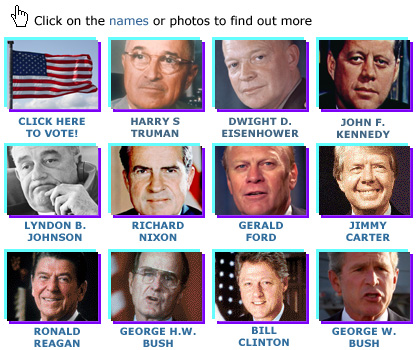
Poll closed but see the contenders
Harry S Truman
6.87%
Dwight D. Eisenhower
3.17%
John F. Kennedy
16.61%
Lyndon B. Johnson
5.43%
Richard Nixon
4.13%
Gerald Ford
0.74%
Jimmy Carter
8.08%
Ronald Reagan
20.75%
George H.W. Bush
0.81%
Bill Clinton
29.61%
George W. Bush
3.80%
2709 votes so far. The poll is now closed - result on today's show!
On 4 November 2008 Americans elected Barack Obama the 44th President of the United States.
How have predecessors tackled that responsibility, and in what areas did they succeed and in what did they fail? In a transatlantic reprise of the Daily Politics Favourite Prime Ministers series , we looked back at the presidencies of those who followed Roosevelt and the Second World War into the Oval Office, right up to the present incumbent, George W. Bush.
Is it about personality and charisma or about policy and social change? JFK had the former but was only President for just over two years; Nixon's presidency was dominated by bad headlines but do they hide more noble achievements?
The Daily Politics viewers' have voted for their favourite post-war US president!
Harry S Truman 1945-53, Democrat
Occupation before president : Soldier, bank clerk, farmer
Truman moved from VP to president following the death of Roosevelt. At the end of World War II, he was party to some of the most crucial decisions in history, including Hiroshima, Nagasaki and the United Nations charter signing.
During his Presidency, he presented a programme to Congress including proposals for the expansion of social security, full-employment, a Fair Employment Practices Act, and public housing and slum clearance.
As Supreme Commander of Allied forces Eisenhower oversaw the D-Day Landings. He ran for president under the slogan "I like Ike", defeating Adlai Stevenson twice.
At home, Eisenhower's administration continued most of the New Deal and Fair Deal programs, emphasised a balanced budget and began desegregation of schools and the military, while foreign policy was defined by the growing Cold War with the Soviet Union and China.
Before he left office, concerns about the relationship between government and the arms industry led him to warn of the rise of a "military-industrial complex".
Kennedy's economic programme prompted the longest sustained expansion of the US economy since the war. He also called for new civil rights legislation and is credited with starting the race to the moon.
In October 1962 US spy planes spotted Soviet missile silos being built in Cuba. For two weeks the world trembled on the brink of nuclear war before the Russians backed down and agreed to remove the bases.
On November 22, 1963, JFK was killed by an assassin as his motorcade wound through Dallas, Texas. He was the youngest elected President and was the youngest President to die.
On November 22, 1963, just two hours after Kennedy's assassination, Lyndon Johnson was sworn in as President, Jackie Kennedy beside him. His first act was to push through JFK's civil rights bill and tax cuts.
He won the Presidency in his own right in 1964, with 61% of the vote and the widest margin in American history. He hailed "a new era" in space exploration when three US astronauts orbited the moon in 1968.
His domestic legacy includes civil rights legislation, Medicare, urban renewal, crime prevention and increased voting rights. But abroad, the Vietnam war raged with increasing numbers of US troops being killed.
Nixon had served as Eisenhower's VP before losing the 1960 election to JFK. When he did enter the Oval Office, the US was painfully divided with unrest in its cities and war overseas.
Nixon ended the draft and the Vietnam war, introduced anti-crime laws and, in 1969, saw US astronauts make the first moon landing. Visits to Beijing and Moscow eased Cold War tensions and he negotiated a treaty to limit nuclear weapons.
But the 1974 Watergate scandal brought fresh divisions in the US. Faced with impeachment Nixon resigned to allow, he said, a "process of healing... desperately needed in America."
Elevated to the Presidency after Nixon's resignation, Gerald Ford was faced with inflation, a depressed economy, chronic energy shortages and international conflict.
At home, he vetoed dozens of non-military spending bills to control a spiralling budget deficit. Abroad, the US helped stave off renewed Middle East conflict by giving aid to both Israel and Egypt, while new limits on nuclear weapons were agreed with the USSR.
Ford lost the 1976 election to Jimmy Carter, who remarked in his inauguration speech: "I want to thank my predecessor for all he has done to heal our land."
Jimmy Carter promised to make government "competent and compassionate".
He worked to tackle inflation and unemployment, established a national energy policy, reformed the civil service and deregulated the trucking and airline industries.
With the Camp David agreement of 1978, he helped bring Egypt and Israel together after years of hostility and conflict.
The consequences of Iran holding Americans captive contributed to his defeat in 1980. Iran finally released the 52 Americans the same day Carter left office.
The so-called Reagan Revolution aimed to reinvigorate the American people and reduce their reliance on government.
Reagan obtained legislation to stimulate economic growth, curb inflation, increase employment, and strengthen national defence.
Abroad, he declared war on international terrorism, sending American bombers against Libya after evidence came out that Libya was involved in an attack on American soldiers in a West Berlin nightclub.
In keeping with the Reagan Doctrine, America supported to anti-Communist insurgencies in Central America, Asia, and Africa.
The first President Bush faced a changing world, as the Cold War ended and the Communist empire broke up.
His greatest test came when Saddam Hussein invaded Kuwait, then threatened to move into Saudi Arabia. Bush sent 425,000 American troops, joined by 118,000 troops from allied nations.
After weeks of air and missile bombardment, the 100-hour land battle Operation Desert Storm routed Iraq's million-man army.
But Bush was unable to withstand domestic discontent at home from a faltering economy, rising violence in inner cities and continued high deficit spending. His presidency lasted just one term.
Bill Clinton was the first Democratic president since Franklin D. Roosevelt to win a second term.
He proposed the first balanced budget in decades and actually achieved a budget surplus. But a huge programme of health care reform failed.
In 1998, as a result of issues surrounding his "relationship" with Monica Lewinsky, a young White House intern, Clinton became the second US president to be impeached by the House of Representatives (Andrew Johnson was acquitted in 1868).
He was tried in the Senate and found not guilty of the charges, and he left office with the highest outgoing approval rating (65%) of any president since WWII.
Eight months after his controversial election victory in January 2001, the nature of George W. Bush's presidency changed in a morning.
On the morning of September 11, 2001, terrorists attacked the World Trade Center and the Pentagon.
Since then, President Bush has sent armed forces to Afghanistan and Iraq, two conflicts that will define his time in office.
At the moment, he faces unprecedented levels of unpopularity, as back home America's economy weakens and falters, amid raising prices. But who will it help: McCain or Obama?


 E-mail this to a friend
  Printable version


 Profile of Truman, with history professor Kathleen Burk and actor David Soul


 This man eats news


Bookmark with:
What are these?