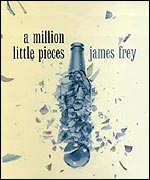
In a special edition from the Hay Festival, Newsnight Review discussed A Million Little Pieces by James Frey.
(Edited highlights of the panel's review taken from the teletext subtitles that are generated live for Newsnight Review.)
BILL BUFORD: This book is very special. I did a random sampling of recurrent phrases, perfectly statically valid. I did another ten pages, then divided it by the number of pages to get the number of phrases per page. I discovered some things which I want to share. On average, the word "vomit" is used 1,022 times. The word "blood" is used 573 times. The Hemingway use of "and" like "I was thirsty and I got up and I had water and it was cold, and it was good, and I wasn't thirsty. The word "and occurs 5,623 times, an average of 16.8 times per page. The omnipresent "I" is used a staggeringly 65,353 times.
WARK:
But did you like it?
BILL BUFORD:
This book is really tedious! This is an affluent kid from Cleveland, from the suburbs, with good parents, who love him dearly, and he does drugs. This is this year's detox book. Oh, there's something else I discovered. In the Tatler they have rehab during your gap year. Rehab is really cool. Last year, it was Rick Moody. Before that it was Rosy Boycott. It is this year's detox book. Ergh!
RACHEL HOLMES:
There is a lot of vomit and hugging. Word on word, there is more hugging...
BILL BUFORD:
But hugging is more revolting.
RACHEL HOLMES:
But it presents itself as a confessional memoir. It is a thinly disguised self-help life coaching book that is deeply sentimental.
KIRSTY WARK:
Oh, but hang on, he didn't go through all this!
GERMAIN GREER:
Oh, no he didn't! This is a memoir, not a novel. But it is intensely novelised. It is full of extremely artful interchanges. It also has ludicrous moments when the writer becomes the hero as when he goes through the dentists' ordeal without flinching. What does he do? He goes to rescue the girl. That is such hogwash. But it is also complete hogwash that he was that sick. I'm telling you, if he had done the drugs he said he did, he would suffer neurological damage. He starts off the book coughing his bloody guts up, his heart is in trouble, his lungs are in trouble, his liver is in trouble. And, in fact, half way through the book we have forgotten all that. He doesn't get any remedial treatment. He is just reborn by the power of Lurve! This is the greatest load of old crap!
HARI KUNZRU:
I didn't like the book much either. But he starts to get interesting. There are the beginnings of relationships with some other people in the hospital. That's the point where I stopped skipping. I became interested in Leonard the mobster. I can't quite believe the bit where it says, "You are my son." That seems intensely novelised. I think this whole business of oscillation between memoir and novel is interesting. It feels like a very worked piece. It is presenting itself as extremely direct.




 E-mail this story to a friend